|
A Timeline of Historic Preservation in San Diego, Part III, 2020–2026
By Alana Coons
September/October 2026
Editor's Note: This third installment traces the years 2020–2026, which concludes the series.
By the beginning of the 2020s, historic preservation in San Diego had matured into an established civic practice supported by decades of ordinances, landmark designations, and community advocacy. Yet the decade also ushered in one of the most consequential periods in the movement's history. Preservation increasingly occupied crucial space at the intersection of housing policy, climate resilience, infrastructure investment, and economic development. While restoration projects and reports on historic neighborhoods demonstrated the enduring cultural and economic value of historic places, sweeping proposals to reshape preservation laws and review processes raised fundamental questions about the future of historic resource protection.
The era was defined not only by the preservation of individual landmarks and designation of historic districts, but also by efforts to protect, evaluate, and adapt the legal and public policy framework that had made preservation possible for more than half a century.
An often-overlooked chapter of preservation history is that protecting historic places also requires sustaining the organizations that advocate for them.
SOHO, being San Diego’s only countywide preservation organization, grew in influence, resources, and public impact. However, its prominent position also made SOHO the subject of external attempts to redirect its mission and gain control. Through strong governance, dedicated supporters, and a steadfast commitment to its mission, SOHO successfully resisted these efforts, reaffirming the group’s reputation for integrity and its purpose, allowing it to continue its more than five decades of advocacy, education, and stewardship on behalf of San Diego’s historic resources and rich heritage.
Community-based preservation expanded throughout San Diego County, building on an initiative that SOHO began years earlier. The formation of neighborhood groups, such as Mission Hills Heritage, Heart of Kensington, and La Playa Heritage, along with the growing preservation efforts of existing ones, such as the North Park Historical Society, La Jolla Historical Society, La Mesa Historical Society, and others, reflected a broader grassroots movement led by residents, historians, and community advocates. These groups expanded preservation beyond individual landmarks to encompass historic districts, cultural landscapes, and the unique identities of San Diego’s neighborhoods.
Historic preservation also became increasingly intertwined with statewide housing legislation. Beginning in 2023, a series of state and local housing initiatives fundamentally reshaped the conversation surrounding historic preservation in San Diego, placing decades-old preservation policies in direct dialogue with California's heightened efforts to address its housing crisis.
Bills including the controversial SB 10 and SB 79, and subsequent cleanup legislation, generated continuing debate over the balance between housing production and the protection of historic districts and designated resources. Preservation organizations increasingly devoted efforts to legislative and regulatory policy in Sacramento in addition to local preservation battles.
Organized misinformation campaigns forced preservationists to repeatedly explain what has been factually proven time after time that historic preservation does not prevent housing from being created nor stop development; adapting old buildings into desirable new housing has locally and nationally successful track records.
In 2026, historic preservation in San Diego has entered a markedly different era from the movement that emerged during the 1960s and ‘70s. While restoration of major landmarks continues, much of the preservation community's work now centers on defending existing legal protections, demonstrating preservation's economic and environmental value through research, and adapting decades-old preservation policies to contemporary challenges involving housing, climate resilience, infrastructure, and urban growth. The focus has shifted from simply saving individual buildings to sustaining the public policies and community values that make preservation possible and viable.
Arguably, one of the most important preservation victories in San Diego of the 21st century to date saved the 1914 Cabrillo Bridge and Balboa Park’s historic core, a National Historic Landmark District. After years of advocacy led by SOHO with architects, engineers, former planners, and community leaders, the City abandoned proposals to destroy part of the iconic bridge with a modern off-ramp leading to a proposed new parking structure. Instead, rehabilitation of the intact historic bridge moved forward and was completed in 2015, preserving one of San Diego's most recognizable civic landmarks, while demonstrating that historic infrastructure can continue to serve today’s transportation needs through sensitive restoration rather than replacement.
These preservation efforts have helped enable continued restoration and rehabilitation throughout Balboa Park’s historic core, including the completion of the Palisades Plaza in 2020, the restoration of the San Diego Automotive Museum in 2021, and the ongoing restoration of the Municipal Gymnasium. These projects reinforce the principle that thoughtful rehabilitation of historic civic landscapes can accommodate contemporary use while preserving the integrity of the park’s 1915 and 1935 expositions. These accomplishments would not have been possible under earlier redevelopment proposals that disregarded preservation’s value and envisioned major excavation and roadway construction through the park's historic core.
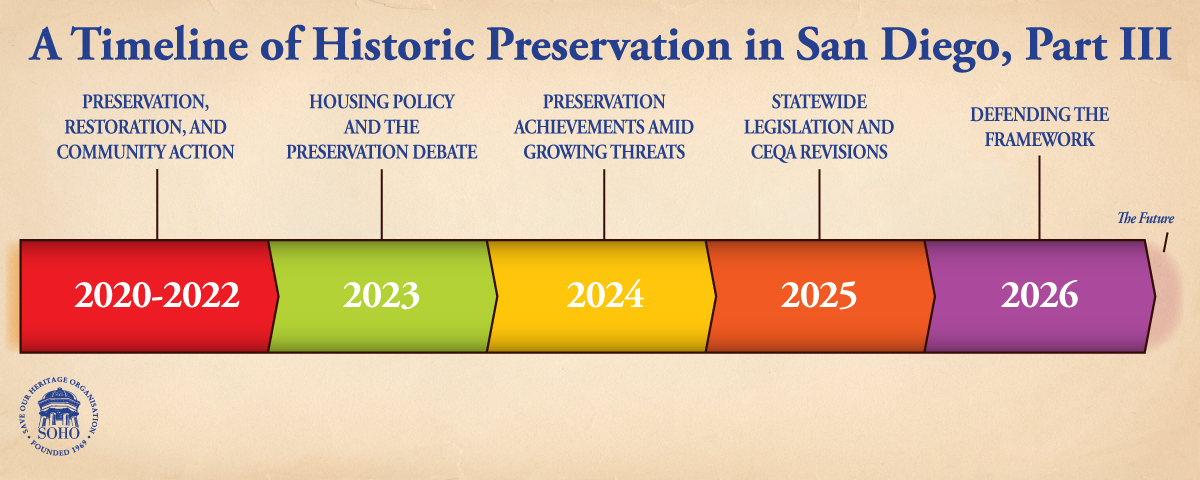
2020–2022: Preservation, Restoration, and Community Action
- 2020: Spearheaded by the Committee of 100, the south Palisades project transforms a deteriorating asphalt parking lot near the San Diego Air & Space Museum, San Diego Automotive Museum, and Municipal Gymnasium into a public square, adding trees and landscaping, and restoring the area to its intended 1935 purpose.
- 2021: Mission Hills Heritage achieves National Register designation for the Inspiration Heights Historic District, creating the first nationally recognized residential historic district in San Diego. The approximately 100-property district reflects early 20th-century City Beautiful planning principles with a cohesive collection of Prairie School, Arts and Crafts, and Period Revival architecture. After years of local efforts delayed by the city, Mission Hills Heritage pursues a National Register nomination, raises funds, conducts outreach, and coordinates extensive volunteer research and documentation. The designation demonstrates the growing role of community-led preservation efforts in protecting San Diego’s historic neighborhoods.
- 2021: The Committee of 100 completes an eight-year, $750,000 effort to restore the former California State Building, now home to the San Diego Automotive Museum, to its 1935 appearance. Guided by historic research, the project restored the building’s historic colors and recreated its monumental tile murals, decorative ornamentation, rooftop grizzly bears, flagpoles, and original signage.
- 2022: Presidio Park - Preservation advocates oppose adversely affecting the Junípero Serra Museum and Presidio Park, arguing that changes to one of California's earliest historic landscapes, to provide catering access threaten the archaeological resources, including the casamata, associated with the birthplace of European settlement in California. This remains active in 2026.
2023: Housing Policy and the Preservation Debate
- 2023: An Independent Budget Analyst (IBA) report evaluates the City’s Historic Resources Program and its relationship to development review. The report finds that the preservation program very rarely impedes development or building permit processing, and recommends changes to existing preservation policies and procedures. The report and its recommendations initiate a broader public discussion about the future of San Diego’s Historic Resources Ordinance and launch a multi-year debate over whether preservation regulations should be revised, strengthened, or reduced.
- 2023: The demolition of a beloved historic bungalow at 820 Fort Stockton Drive in Mission Hills becomes one of the neighborhood’s most significant preservation losses in recent years. Despite substantial community opposition and efforts led by Mission Hills Heritage, the City of San Diego Historical Resources Board declines to designate the property as historic, and allows demolition to proceed. The loss of the small red bungalow—an important contributor to the neighborhood’s character and sense of place—highlights the challenges facing historically significant but undesignated resources throughout San Diego. The property remains an empty lot, underscoring the irreversible nature of historic resource loss.
- 2023: The former Mission Hills Branch Library becomes a major preservation success story. The Historical Resources Board declares it a historic resource in 2020 for its distinctive Contemporary Style with Futurist Modern and Googie influences. The designation is appealed and ultimately upheld in 2023 by the San Diego City Council, responding to a strong community preservation effort led by Mission Hills Heritage.
- 2023: Implementation of California Senate Bill 10 (SB 10), intending to create higher-density housing near public transit sparks one of the largest grassroots preservation efforts in recent San Diego history. The debate marks an early stage in the growing tension between statewide housing mandates and locally devised historic preservation programs, while also challenging local control of zoning and development. Senate Bill 10, which was passed into law, becomes one of the most consequential housing policy debates ever to involve historic preservation statewide. With the law’s potentially disastrous impacts on historic neighborhoods, SOHO, Neighbors for a Better San Diego, the Neighborhood Historic Preservation Coalition, and numerous community organizations mobilize more than 900 residents to participate in person during the public review process. Following this extensive testimony, the San Diego Planning Commission directs staff to reconsider the poorly conceived proposal, backed by an anti-preservation mayor. Planning Commission Chair William Hofman characterizes the mayor’s proposal as "fatally flawed," reflecting the significant policy questions raised by opponents. Ultimately, the city exercises its local discretion to exempt designated historic resources and historic districts from its SB 10 implementation. This outcome preserves protections for designated historic resources while highlighting continuing concerns for eligible but undesignated historic neighborhoods. The intense debate that SB 10 ignited continues to shape preservation policy.
2024: Preservation Achievements Amid Growing Threats
- 2024: The La Jolla Park Coastal Historic District is listed in the National Register of Historic Places, recognizing one of San Diego’s most significant cultural landscapes. The 8-acre district encompasses approximately 2.5 miles of coastline and includes natural, architectural, and landscape features associated with the development of La Jolla Park beginning in 1887. Thirty-five contributing resources in the district include ten buildings (including two previously listed landmarks), eight sites, and seventeen structures. Among them are the endangered Red Roost and Red Rest cottages. The designation reflects growing recognition that historic preservation extends beyond individual buildings to include cultural landscapes, public spaces, and places shaped by generations of human presence and connection. Community stewardship efforts led by Friends of Coast Walk Trail help protect and maintain this treasured resource.
- 2024: The City of San Diego launches its Preservation and Progress project with the most sweeping restructuring of San Diego's preservation program since the adoption of its Historic Resources Ordinance in 1965. Based on development interests instead of preserving our heritage, proposed revisions affect historic designation, review procedures, district protections, Mills Act eligibility, appeals, and development review with a cumulative effect that will substantially weaken the city's preservation framework.
- 2024: The Talmadge Park Estates Historic District is officially listed in the National Register of Historic Places on March 25, 2024, becoming the largest historic district in San Diego County. The 138-acre district encompasses nearly 600 resources dating from 1926 through the post–World War II era as well as its distinctive wrought iron gates and historic acorn streetlights. Led by the Talmadge Historical Society under the leadership of Laura Henson and Geoffrey Hueter, residents complete extensive research and documentation to prepare the nomination. The designation represents a significant community-driven preservation achievement and demonstrates the growing recognition of historic neighborhoods, suburban development, and everyday places as important parts of San Diego’s architectural and cultural heritage.
- 2024: The Botanical Building in Balboa Park reopens following a comprehensive $28.5 million restoration, marking one of San Diego’s most significant preservation achievements of the decade. Built for the 1915 Panama-California Exposition and designed by San Diego architect Carleton Winslow under the direction of exposition architect Bertram Goodhue, the predominantly wood lathe building is one of only four permanent structures remaining from the exposition and a defining symbol of Balboa Park’s architectural legacy.
2025: Statewide Legislation and CEQA Revisions
- 2025: Rather than being demolished or replaced, the former Mission Hills Branch Library building finds new life through adaptive reuse as Library Shop Mission Hills, an independent neighborhood bookstore and community gathering space opens in 2025. The project demonstrates the value of preserving and reusing historic resources as active community assets.
- 2025: California enacts Assembly Bill 130 and Senate Bill 131, creating one of the most significant revisions to the California Environmental Quality Act (CEQA) in decades. By expanding statutory exemptions and streamlining approval for broad categories of housing and infrastructure projects, the legislation substantially reduces the number of projects and developments requiring environmental review. Although the bills do not directly amend California's historic preservation laws, preservation organizations warn that fewer projects subject to CEQA review will also mean fewer opportunities to identify, evaluate, publicly disclose, and mitigate impacts to historic buildings, archaeological sites, cultural landscapes, and other historic resources before they are altered or demolished.
- 2025: California Senate Bill 79 (SB 79), addressing transit-oriented housing development, sets off significant statewide policy debates affecting historic preservation. The debate that began in 2023 with SB 10 continues to simmer as California pursues additional statewide housing legislation, bringing historic preservation increasingly into discussions traditionally focused on zoning and housing production. While the legislation seeks to encourage housing production near public transit, preservation advocates raise alarms that it did not adequately account for historic neighborhoods, designated resources, eligible historic properties, and the cultural landscapes that define communities. Amendments are introduced to provide protections for certain historic resources; however, the proposed safeguards are insufficient because they exclude many eligible but not yet designated resources and create limitations that can leave historic districts vulnerable.
2026: Defending the Framework
- 2026: SOHO sues the City after the San Diego City Council approves the Preservation and Progress Package A, despite extensive public opposition, repeated concerns raised by preservation groups, and two recommendations against approval by the Historical Resources Board. SOHO’s lawsuit, filed under the California Environmental Quality Act (CEQA), maintains that the City failed to adequately evaluate the impacts on historic resources before adopting Package A’s so-called reforms. The litigation represents one of the most significant legal challenges in the history of San Diego's preservation program and underscores the growing role of the courts in resolving conflicts between preservation policy and development priorities.
- 2026: SOHO commissions PlaceEconomics to conduct a comprehensive study of the economic, social, environmental, and housing benefits of San Diego’s historic districts, in collaboration with preservation partners Mission Hills Heritage and Talmadge Historic District leaders Geoffrey Hueter and Laura Henson. The resulting report, The Urban Vitality Blueprint: A Data-Driven Analysis of Equity, Affordability, and Vitality in San Diego’s Historic Districts, provides one of the region’s most comprehensive quantitative analyses of preservation’s contributions to affordability, sustainability, neighborhood stability, equity, and economic vitality.
- 2026: Proposed accessibility alterations to improve access primarily for catering service at the Junípero Serra Museum in Presidio Park would damage archaeological resources, historic topography, mature trees, and George W. Marston’s 1929 landscape features. Proposed grading, excavation, road and parking modifications, and structural interventions would disturb, and potentially destroy, significant archaeological deposits associated with the 1769 Spanish presidio. Preservation advocates challenge the City’s use of a Mitigated Negative Declaration rather than a full Environmental Impact Report and call for evaluation of a less destructive ADA alternative.
- 2026: Bungalow Court MPDF - The University Heights Historical Society, led by Kristin Harms, spearheads a successful countywide Multiple Property Documentation Form (MPDF) for San Diego’s historic bungalow courts, establishing a framework to streamline their recognition and protection. Approved unanimously by the California State Historic Resources Commission, the MPDF helps preserve one of San Diego’s most distinctive residential forms and enduring sources of affordable housing
- 2026: Red Roost and Red Rest - More than fifty years after preservation efforts first began, the Red Roost and Red Rest cottages overlooking La Jolla Cove remain the focus of one of San Diego’s longest-running preservation campaigns. Despite designation, various redevelopment proposals, fire damage, negotiations with multiple owners, and decades of uncertainty, the City forwards a new and incomprehensible proposal to demolish these cottages considered forerunners of the Arts and Crafts bungalow.
- 2026: SDG&E proposes the Golden Pacific Powerlink, a 145-mile high-voltage transmission corridor crossing portions of Southern California's desert backcountry. Preservation advocates raise concerns over negative impacts to Anza-Borrego Desert State Park, the Warner–Carrillo Ranch House National Historic Landmark, the Southern Emigrant Trail corridor, Indigenous cultural sites, and one of the state's most intact historic landscapes. The threats call attention to a growing preservation principle that cultural landscapes—including viewsheds, historic settings, archaeological resources, and natural environments—are integral components of historic significance and cannot be separated from the landmarks they surround.
- 2026: Proposed revisions to the regulations implementing Section 106 of the National Historic Preservation Act mark one of the most consequential federal preservation policy debates since the act’s passage in 1966. If adopted, the changes would substantially alter or end the collaborative review process that has guided federal agencies, states, Tribal Nations, local governments, preservation organizations, and the public in identifying and addressing impacts to historic sites and properties involved in federal projects for nearly sixty years. Preservation organizations across the nation characterize the proposal as a fundamental redefinition of the federal government's historic preservation responsibilities, concluding a decade in which preservation increasingly shifted from protecting individual landmarks to defending the legal frameworks upon which preservation itself depends.
Looking Forward: By the middle of the 2020s, historic preservation in San Diego entered a new chapter. Earlier generations fought primarily to save individual landmarks from demolition. The challenges of the twenty-first century increasingly involve protecting historic districts, cultural landscapes, archaeological resources, and the legal frameworks that guide governmental preservation decisions. Housing policy, environmental review, infrastructure planning, and federal regulatory reform have become as central to preservation as restoration itself. The story of preservation in San Diego continues, not only in the rehabilitation of historic places, but in the ongoing effort to ensure that the laws, public processes, and community values that have protected them for more than half a century endure for us and for future generations.
Catch up with Part I and Part II online.
Please note any corrections, suggestions, or additions. We eagerly welcome them.
This three-part timeline project spans the 19th century through 2026, a somewhat enormous undertaking involving extensive research. We fully expect that we have missed important items or may have made mistakes along the way.
Please help us keep this crucial record as accurate and comprehensive as possible. Send your comments to SOHO@SOHOsandiego.org.
BACK to table of contents
|
2026
2025
2024
2023
2022
2021
2020
2019
2018
2017
2016
2015
|