|
A Timeline of Historic Preservation in San Diego, Part I, 1871-1989
By Alana Coons
May/June 2026
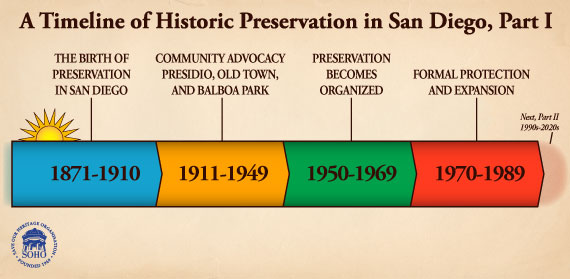
For National Preservation Month in May 2026 and in anticipation of the 250th Anniversary of our nation’s founding, Save Our Heritage Organisation (SOHO) presents a two-part overview of important milestones that have shaped historic preservation in San Diego.
In Part I, we trace the emergence and evolution of San Diego’s preservation consciousness, from the 1870s through the 1980s. Over more than a century, preservation's emerging framework eventually took hold.
Part II, which will appear in the July-August 2026 issue of Our Heritage eNews, begins with a renewed advocacy strategy in the 1990s. This broader approach continues into the 21st century, as SOHO and the national preservation movement have transitioned from a focus on individual, high-profile sites and monuments to emphasizing historic districts, neighborhoods, cultural histories and landscapes, and sustainable communities.
The story of historic preservation and of nurturing public awareness of its importance in San Diego stretches back to the late 19th and early 20th centuries, then lies largely quiet until reemerging in the 1960s as a modern preservation movement.
What follows is not a comprehensive history, but a snapshot of key moments in a long and evolving effort to recognize, protect, and value the places that tell our region’s story.
Because SOHO has played a leading role in preservation since its founding in 1969, we have scaled back its outsized presence in the record outlined here so that the timeline reflects the broader preservation community. Still, SOHO's leadership remains the dominant throughline.
Today, historic preservation in San Diego focuses on protecting structures, districts, and landscapes that define the region's diverse 12,000-year history, from Native American and Spanish roots to modern development.
Decades of experience support the continuity of the preservation story in San Diego—from 1890s philanthropy to 1910s civic pride, from 1960s activism to recent decades of professional advocacy, on up to today’s policy debates.
1871–1910: The Birth of San Diego's Preservation Consciousness
- 1870s: George W. Marston emerges as a preservation leader
In 1871, Marston joins W.B. Bancroft, José G. Estudillo, Douglas Gunn, E.W. Morse, and José Antonio Serrano in the fight to protect San Diego’s City Park—now Balboa Park—from real estate speculators. Though city officials reserve the 1,400-acre parkland in 1870, developers covertly enlist a state senator to introduce a repeal bill. The repeal fails, marking the first major grassroots victory for the park. Marston goes on to champion Balboa Park’s protection for the rest of his life.
- 1890s–1900: San Diego Landmarks Club founded by Marston
By this time, Marston is known as a businessman, philanthropist, and civic visionary. He becomes involved with the Landmarks Club of California, founded to preserve California missions and historic places, placing San Diego within the earliest statewide preservation movement. Marston establishes the San Diego chapter of the Landmarks Club of California, focusing on stabilizing and restoring Mission San Diego de Alcalá with technical help from architect Irving J. Gill. This is arguably San Diego’s first organized historic preservation effort, decades before any municipal ordinance. Preservation is now tied to civic identity, with Marston’s advocacy linking history, parks, architecture, and public good—a philosophy that underpins San Diego preservation efforts to this day, quality of life, beauty, continuity, education, health and well-being.
- 1907–1908: Restoration of the Casa de Estudillo in Old Town begins
Financier and businessman John D. Spreckels commissions Hazel Wood Waterman, San Diego's first woman architect, for the project intended to attract visitors to Old Town during the upcoming 1915 Exposition. Historic preservation as a driver of tourism economy begins.
- 1907–1926 — Land assembled to create Presidio Park
Known as the Plymouth Rock of the West, George Marston and his partners begin acquiring this land in 1907 to save the historic site from development. Marston later buys out his partners and continues acquiring additional parcels. By 1915, he has secured 14 lots and, by 1926, expands the holdings by another 20 acres.
1910–1949: Community Advocacy, Presidio Park, Old Town, and Balboa Park
- 1915–1916: Panama-California Exposition
The exposition introduces Spanish Colonial Revival architecture on a monumental civic scale. While many buildings are intended as temporary, San Diegans quickly fall in love with them and begin planning for their preservation.
- 1920s–1930s: Early community advocacy to save Exposition buildings
In 1922, and again in 1933, impassioned citizens successfully organize to prevent demolition of the exposition structures. This early example of grassroots architectural advocacy occurs well before historic preservation was a formal field. Richard S. Requa, the 1935 Exposition’s chief architect, summed up the emotions of many—then and now—as he approached the restoration or repairs to the surviving 1915 buildings. Underscored by his “feeling of reverence,” Requa wrote, “Attempts to alter or improve [the 1915 structures] would have been acts of sacrilege.”
- 1930: George Marston donates Presidio Park to the City of San Diego
Having assembled the land to protect the historic site from development, he donates it to the City with the intent that it be preserved in perpetuity.
- 1931 California Historical Landmarks (CHLs) program begins
Legislation authorizes the Department of Natural Resources to register and mark buildings of historical interest. The first twenty landmarks, including some in San Diego, are officially designated on June 1, 1932 ; the California State Chamber of Commerce administers the program.
- 1931–1932: Marston turns his attention to Old Town San Diego. He restores the crumbling Ruiz-Carrillo Adobe in 1931. In 1932, he enlists designer Cliff May to restore El Campo Santo cemetery, focusing on rebuilding its adobe wall.
- 1935–1936: California Pacific International Exposition
Reinvestment in Balboa Park reinforces the idea that historic civic architecture can be adapted, reused, and re-imagined rather than discarded. The exposition further expands Balboa Park and generates income used to preserve buildings from the 1915 exposition.
- 1937: The Works Progress Administration (WPA) rebuilds the Old Adobe Chapel (originally built in 1850) as a replica. This is one of the first major federally funded preservation projects in Old Town, alongside El Campo Santo, and the Calvary Roman Catholic cemetery in what is now Mission Hills Pioneer Park. The legacy of the WPA endures in San Diego’s historic architecture and preservation laws. As America’s first national commitment to preservation, it laid the groundwork for the National Historic Preservation Act. Through restoration, design, and the arts, the WPA supported recovery while fostering public pride—and helped advance key measures including the National Archives and Records Administration (1934), Historic Sites Act, and the Historical Records Survey (1935).
1950–1969: Preservation Becomes Organized
- 1956–1969: Within Old Town, restoration activities boom from 1956 to 1969. Five historic sites are saved and restored during this period: the Whaley House in 1956, the Mason Street School in 1962, the Casa de Pedrorena in 1968, and the Casa de Estudillo and Casa de Machado-Stewart in 1969. In addition to the restoration of buildings within Old Town, previously demolished resources are also reconstructed, including the Casa de Lopez in 1963. Buildings are relocated to avoid demolition; for example, the Derby-Pendleton House, constructed in 1851, is moved to its current location on Harney Street in 1962.
- 1965: City of San Diego adopts its first Historic Preservation Ordinance
Preservation becomes municipal policy rather than solely philanthropic or volunteer-driven.
- 1967: The Committee of One Hundred is launched
Formed to preserve and restore Balboa Park's historic Spanish Colonial Revival architecture, gardens, and public spaces, in response to the demolition of buildings on the Plaza de Panama.
- 1967: City of San Diego Historical Site Board (now the Historical Resources Board) is formed
Provides a formal public body comprised of citizen volunteers to review, designate, and protect historic resources.
- 1968: Old Town San Diego State Historic Park
The park is created to preserve the historic beginnings of the city.
- 1969: Save Our Heritage Organisation (SOHO) is founded
Artist Robert Miles Parker sounds the alarm, and founds SOHO in response to threats against San Diego's Victorian homes, beginning with the 1887 Sherman-Gilbert House—saved from demolition and later moved to what becomes Heritage Park, a newly created San Diego County park initiated by SOHO. The grassroots group forms to serve the community and quickly becomes a catalyst for preservation, raising awareness and appreciation of the city's architectural and cultural heritage.
1970–1989: Formal Protection and Expansion
Landmark designations for individual buildings, sites, and cultural landscapes expand across neighborhoods, and these resources are formally protected by law, while SOHO emerges as the city’s leading watchdog and educator. Through advocacy, publications, tours, and awards programs, SOHO shapes public understanding of what preservation means and why it matters.
- 1970: The California Environmental Quality Act (CEQA)
Signed into law as a foundational statute, CEQA requires state and local agencies to identify, disclose, and mitigate significant environmental effects of proposed projects, including impacts on historical resources. A “substantial adverse change,” such as demolition, destruction, or alteration to a historical resource, is considered a significant environmental effect. CEQA is the primary legal tool used to protect historic resources in California.
- 1971: Old Town is listed on State and National Registers
Recognition of San Diego’s earliest settlement area comes about under the leadership of San Diegan and California Senator James Mills. Old Town San Diego State Historic Park is listed in 1971 as a National Register Historic District.
- 1971: The County Board of Supervisors purchases a 7.8-acre site at Juan and Harney Streets in Old Town working in partnership with SOHO to create an “1880s-style Victorian building preserve,” known today as Heritage Park.
- 1971: Villa Montezuma at 20th and K Streets
Working in partnership to save the Villa are SOHO, the Historical Site Board (now the Historical Resources Board), the American Institute of Architects (AIA) San Diego Chapter, and the San Diego Historical Society.
- 1972: The Mills Act is enacted
This state bill carried by Senator James Mills will turn out to be preservation's single most important economic incentive program in California, and San Diego is the second city to adopt it. Designed to encourage the preservation, maintenance, and restoration of designated historic properties, preservation becomes linked to private property stewardship, not just public monuments.
- 1972: SOHO chairman Barry Worthington leads the organization with the strong effort to save the Santa Fe Depot, at the foot of Broadway, from demolition. Over the years, the depot is threatened and ultimately saved by SOHO three separate times, underscoring both the landmark's vulnerability and its significance.
- 1974: Civic leaders, including Tom Ham and SOHO, promote a series of plans to establish the Gaslamp Quarter as a city center and new national historic district. The Marston family underwrites a plan by urban planners Kevin Lynch and Donald Appleyard called Temporary Paradise? that proposes the district as a catalyst for urban renewal. The Gaslamp Quarter is added to the National Register of Historic Places in 1980.
- 1974: William Cartwright, president of SOHO, saves the Italianate Bushyhead House, spearheading and donating $6,000 to move it from Cedar Street to Third Street for temporary safekeeping.
- 1975: First Irving Gill architecture tours are led by SOHO and the AIA’s Women's Architectural League, recognizing the forgotten architect's national and international role as the father of Modernism. SOHO goes on to become the most dominate advocacy voice in the region for Gill's work.
- 1976: SOHO relocates the Classic Revival–style Burton residence, the Victorian-era Queen Anne–style Christian House, and the Bushyhead House to Heritage Park in the summer of 1976.
- 1976: Two buildings in the downtown redevelopment area—the Horton Hotel, later known as the Horton Grand Hotel, and the Balboa Theatre—become the focus of heated debate as efforts intensify to preserve and reuse them. These struggles build on earlier ideas advanced by SOHO founder Robert Miles Parker, who had proposed years earlier that the entire block be restored as a theater district.
- 1977–78: Marc Tarasuck, architect and SOHO president, leads the effort to save and acquire Senlis Cottage as SOHO's headquarters and to move it to Heritage Park, highlighting the need to save modest historic homes along with the more prominent ones.
- 1977: Balboa Park’s El Prado Complex
Designated a National Historic Landmark(NHL) by the National Park Service, it is the federal government’s highest recognition for historic places. The district includes the Cabrillo Bridge (with approaches and guardhouses), House of Charm, House of Hospitality, Electrical Building, Botanical Building, Organ Pavilion, Alcazar Gardens, Plaza de Panama, El Prado Arcade, Fine Arts Gallery, Casa del Prado (reconstruction), and Natural History Museum.
- 1978: Broadway Fountain at Horton Plaza
Threatened with demolition or removal over the years, the 1910 Irving J. Gill-designed fountain becomes one of SOHO’s most hard-fought preservation battles. SOHO ultimately saves the fountain three times, successfully pressuring the City Council and the Centre City Development Corporation (CCDC) to preserve it and establishing an early precedent for negotiating with major redevelopment agencies. In recognition of this victory, SOHO adopts the Broadway Fountain as its organizational logo. Years later, in 1984, SOHO and others again defeat a proposal by nationally renowned landscape architect Lawrence Halprin to relocate the fountain, which prompts Halprin to famously say he is "fed up" with San Diego's preservation influence.
- 1979: The inconceivable loss of the 1907 Melville Klauber House on Sixth Avenue. SOHO members Jim and Kathleen Kelley-Markham, along with Irving J. Gill historian Bruce Kamerling, form the Friends of Gill as an adjunct of SOHO. The group moves to take legal action in an effort to stop the razing of one of Gill's finest residences. Although the attempt ultimately does not succeed, the case draws attention to the growing role of litigation in preservation, with San Diego Magazine in 1979 predicting that "legal action will become more of a preservation tool in the future.”
- 1980s: Adaptive reuse gains momentum in San Diego
Preservationists promote the rehabilitation and reuse of historic buildings as a practical strategy for revitalizing downtown while protecting architectural heritage. In the Gaslamp Quarter, formerly neglected buildings are restored and adapted for new uses—transforming warehouses into lofts and repurposing historic commercial structures. These efforts help demonstrate to city leaders how preservation can drive economic revitalization while safeguarding historic landmarks.
- 1980: Preservation easement program
SOHO institutes the program to provide protection for historic commercial and residential building facades in perpetuity. Both the City of San Diego and the San Diego Historical Society follow suit and create their own easement programs.
- 1982: San Diego Rowing Club
A seven-year battle between the Port District and preservationists comes to a spectacular end. Chart House Enterprises purchases the bayfront property and restores and adapts the 1887 structure as a restaurant, still operating today. Led by Patricia A. Schaelchlin and Carol Lindemulder, president of SOHO, the city lists the clubhouse as a historic site. In September 1978, the building is placed on the National Register of Historic Places. The years of advocacy with the Port District, state legislators, and the California Coastal Commission pays off.
- 1983: SOHO hosts its first annual People In Preservation Awards
By 2026, 700 individuals or projects have been recognized.
- 1986: Adoption of a County Historic Preservation Ordinance and the County Historic Site Board by the County Board of Supervisors. SOHO is instrumental in the establishment of both.
- The Asian Pacific Thematic Historic District (APTHD) is created, an eight-block district that preserves the heritage of early Chinese, Japanese, and Filipino immigrant communities with 22 structures contributing.
Catch up with Part II and Part III online.
BACK to table of contents
|
2026
2025
2024
2023
2022
2021
2020
2019
2018
2017
2016
2015
|