|
A Timeline of Historic Preservation in San Diego, Part II, 1990–2019
By Alana Coons
July/August 2026
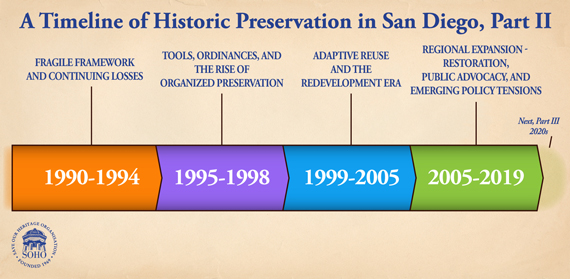
Editor's Note: This second installment traces the years 1990–2019. Part III, covering 2020–2026, will conclude the series in the September–October 2026 issue of Our Heritage eNews.
San Diego’s historic preservation movement entered a new phase in the 1990s, one that was increasingly neighborhood-based and deeply engaged in public policy and legal advocacy. While previous efforts focused primarily on saving individual landmarks, preservationists now extended their focus to include community character, cultural landscapes, bungalow courts, historic districts, and the protection of entire neighborhoods from speculative redevelopment pressure.
During the early 1990s, historic designations increased across the city and county, alongside the emergence of neighborhood preservation organizations and historical societies that became essential local advocates. Groups in Coronado, Kensington, La Jolla, Mission Hills, North Park, University Heights, and other communities helped transform preservation into a region-wide civic movement. In many cases, these neighborhood organizations stepped in as traditional institutions shifted away from direct preservation advocacy.
As a result, a new preservation infrastructure took shape, rooted in residents themselves. Communities began documenting their own histories, conducting neighborhood surveys, and organizing to defend the places that defined local identity and continuity. In 2007, Mission Hills became the city’s first locally designated volunteer historic district, establishing an early model for others.
A review of the decades 1990 to 2019 underscores both the scale of the work and the sacrifices behind it. As SOHO’s timeline shows, preservation victories were significant, but the losses were profound.
Preservation in San Diego has fundamentally been an act of extraordinary public service that often goes unrecognized, even as advocates persist. Time and again, preservationists have devoted years, often decades, to protecting buildings and places because they wholeheartedly believed these landmarks belonged to the public and to future generations.
SOHO’s timeline is necessarily selective. It highlights key moments in the evolution of preservation advocacy, and the people who sustained it, helping ensure that future generations understand how much of San Diego’s historic fabric survived relentless redevelopment pressure, and why many important resources did not.
As the region's leading preservation organization, SOHO's work appears frequently throughout the timeline. Equally important, however, is the budding story of a growing preservation movement, one that now includes more than a dozen preservation and neighborhood organizations working together to protect the historic places that define our communities.
Entire neighborhoods, architectural landmarks, regional parks, cultural landscapes, and historic districts remain in our personal and cultural lives today only because individuals and community organizations refused to accept demolition or unfettered redevelopment as the price of progress.
This era also marked the maturation of preservation advocacy, as legal strategies grounded in the California Environmental Quality Act (CEQA) became increasingly important tools for challenging inadequate environmental review and strengthening public accountability in planning decisions. The fair argument standard further reinforced this approach by requiring environmental impact reports when substantial evidence indicated a potential for significant impacts.
SOHO developed a more structured advocacy framework that often succeeded in slowing or stopping destructive projects while supporting more compatible development. Our growing sophistication in advocacy, presenting feasible alternatives, and legal action could not have come sooner.
For, by the 2010s and into the 2020s, preservation advocates faced a more organized pro-development and YIMBY narrative that often scapegoated historic preservation as an obstacle to affordability and urban progress. Advocates countered those false premises, repeatedly arguing that growth was not the issue, but whether inevitable growth would respect environmental sustainability, cultural continuity, neighborhood character, and the long-term public interest.
Those debates continue to brew today. So too does the steady, public-spirited work of preservation, grounded in the belief that cities are not disposable and that inherited places carry civic and cultural value beyond immediate economic return. At this critical moment in San Diego’s history, the call is simple: Support your local historic preservation organizations and continue the work that began generations ago with civic leaders such as George Marston.
Beginning in 2000, SOHO entered a new phase under Executive Director Bruce Coons and, with strong board leadership, shifted toward a more strategic and collaborative model of preservation advocacy. SOHO increasingly engaged directly with architects, planners, and developers as their proposals were developed and designed.
Drawing on this remarkable collective expertise in historic architecture, construction systems, adaptive reuse, and environmental context, SOHO began proactively providing technical review of development proposals. Significantly, this solutions-oriented approach positioned us as a constructive participant in shaping projects to improve outcomes for both historic resources and surrounding communities. Notable early collaborations included the downtown San Diego Ballpark District and the Hotel del Coronado’s restoration and creative adaptive reuse. In both cases, SOHO’s early and highly informed engagement helped produce preservation-sensitive outcomes and precedent-setting settlement agreements that won national recognition.
At the same time, preservation practice continued to develope into more expansive definitions of cultural heritage, including postwar resources and LGBTQ history, while also requiring stronger enforcement tools to protect historic resources effectively. In 2000, with the urging and support of SOHO and the San Diego County Archaeological Society, the City of San Diego implemented updated Historical Resources Regulations under the Land Development Code (initially adopted in the late 1990s and effective January 1, 2000). These regulations codified requirements for identifying and protecting archaeological sites, establishing that development could only encroach upon significant resources under strict mitigation, monitoring, and documentation measures.
In one of the region’s first initiatives of its kind, SOHO established a Modernism subcommittee composed of architects, historians, and preservation specialists. This group helped create a structured framework for evaluating Mid-Century Modern residences, businesses, and landscapes at a time when they were still largely overlooked in mainstream preservation practice and public consciousness.
From 2003–2005, SOHO led this educational, public-awareness campaign through San Diego Modernism Weekends, among the earliest sustained Modernism programming in California outside Palm Springs. These immersive weekends highlighted UC San Diego’s master-planned Modernist campus, influential regional architects, and broader Mid-Century themes, including San Diego-specific postwar residential design and Tiki style architecture. This all contributed to a Mid-Century Modern historic context statement completed by the City of San Diego in 2007.
In 2012, SOHO brought together community leaders for a landmark meeting at the Marston House Museum, marking the beginning of San Diego's LGBTQ historic preservation movement. Among those participating were Alana Coons, Bruce Coons, Charles Kaminski, Jaye MacAskill, Maureen Steiner, and future Assemblyman Chris Ward. The meeting forged the momentum that led directly to the development of the City of San Diego's LGBTQ Historic Context Statement, San Diego LGBTQ Historic Context Statement (2016), a landmark document ensuring that LGBTQ history became an integral part of the city's historic preservation program.
1990–1994: Fragile Framework and Continuing Losses
Preservation gains remain fragile in the early 1990s as San Diego continues to lose significant historic resources, including the Aztec Brewery (1990) and the Green Dragon Colony (1991). These years underscore the persistent gap between recognition and long-term protection, as historic designation alone often proves insufficient to withstand political and development pressures. Even as preservation policy matures, the City Council does not consistently uphold the City's Historic Site Board designations on appeal, revealing the vulnerability of preservation decisions to political intervention.
Preservation advocacy increasingly shifts toward formal policy tools, litigation, and coalition-building in response to mounting redevelopment pressures and ongoing resource loss.
- 1990: The Balboa Theatre Foundation forms to advocate for the preservation of the historic 1928 Balboa Theatre, beginning a long-term effort that ultimately leads to the building’s acquisition and restoration in 2008.
- 1991: Loma Theatre is adapted for reuse as a Bookstar store. Its historic neon signage is restored on site in 2013.
- 1991: San Diego’s Historic Site Board discontinues its long-standing practice of assigning significance “grades” as part of designation actions, bringing the City’s process into alignment with the legal requirements of state and federal environmental law.
- 1992: City of La Mesa establishes a program to designate properties and contract with owners under the Mills Act for continued conservation.
- 1992: Governor Pete Wilson signs Assembly Bill 2881, authored by San Diego Assemblyman Robert Frazee, establishing the California Register of Historic Resources.
- 1993: Coronado City Council votes to pursue the demolition of the National Register-listed Babcock Court bungalow court for the construction of a new police facility. An irreparable loss to the community.
- 1993: The First Church of Christ Scientist, San Diego, is restored through removal of its 1950s-era alterations, returning one of architect Irving J. Gill’s most significant works to its original appearance.
- 1994: T.M. Cobb Warehouses, long threatened by redevelopment proposals and a controversial high-rise project exceeding Gaslamp height limits, become the focus of a major preservation battle when the City’s Redevelopment Agency moves toward demolition despite prior public opposition. Challenging what it argues is an inadequate Environmental Impact Report under CEQA, SOHO files a landmark lawsuit against the City, the organization's first legal action in its 25-year history.
1995–1998: Tools, Ordinances, and the Rise of Organized Preservation
The mid- to late-1990s mark a turning point when preservation advocacy in San Diego becomes increasingly institutionalized, with the adoption of new policy tools, the development of formal preservation programs, and the expansion of organized public engagement. Preservation efforts shift toward more structured frameworks for protection, documentation, and neighborhood-scale planning.
New legal tools, advocacy strategies, and community-based programs begin to reshape how historic resources are identified, evaluated, and protected across the city.
- 1995: City of San Diego votes unanimously in favor of adoption of the state Mills Act, which reduces property taxes for owners of designated historic properties who commit to using their tax savings to restore and maintain their resources.
- 1995: SOHO creates its Most Endangered List, which becomes one of the organization’s most effective tools for raising awareness and spurring action to protect and restore cultural and historic treasures.
- 1995: Sherman Heights Plan is approved. San Diego City Council adopts the plan, laying the groundwork for the revitalization of Sherman Heights, the historic district designated in 1987 and one of the earliest residential neighborhoods associated with Alonzo Horton’s “New Town." The plan's adoption helped realize the “Livable Neighborhood” model.
- 1996: North Park selected as a Main Street pilot community. North Park is chosen as the pilot community that brings the Main Street program, created by the National Trust for Historic Preservation, to the City of San Diego, helping demonstrate how historic preservation can serve as a catalyst for neighborhood revitalization, economic development, and community identity. Ocean Beach joins the Main Street program in 1997.
- 1997: San Diego’s former Naval Training Center (NTC) begins its transformation for civilian use. After its decommissioning in 1997, NTC becomes one of Southern California's largest preservation-based adaptive reuse efforts. In the following years, the 540-acre military site is transformed into Liberty Station, preserving its Spanish Colonial Revival architecture and ultimately becoming a historic district and mixed-use cultural hub.
- 1997: City of San Diego becomes a Main Street city. San Diego becomes the first large city in the western United States to adopt the National Trust’s Main Streets program.
- 1998: After SOHO lost the court case to preserve the T.M. Cobb Building, which was demolished for a mega-hotel project, the group pays the City’s legal costs and requests that the funds be directed toward a historic preservation-related effort. The Historical Resources Board Policy Subcommittee recommends using the SOHO funds to complete an architecture survey for the Mid-City neighborhoods, helping advance documentation for the proposed historic districts.
- 1998: The Warner–Carrillo Ranch House, a National Historic Landmark, is placed on SOHO’s Most Endangered List. The designation contributes to fundraising and public funding efforts, including a $75,000 donation and state grant support, leading to the acquisition and stabilization of the property. The site is subsequently preserved and restored through a collaborative effort involving its owner, the Vista Irrigation District, and SOHO.
1999–2005: Adaptive Reuse and the Redevelopment Era
Large-scale redevelopment projects define the early 2000s. Historic preservation increasingly intersects with downtown urban renewal, infrastructure investment, and public-private partnerships. Adaptive reuse becomes a dominant strategy, as major commercial, civic, and industrial buildings are reimagined rather than demolished, even as significant preservation losses continue to reflect the ongoing tension between redevelopment and historic preservation.
- 1999–2000: Building on adaptive reuse momentum from the 1980s and the availability of federal historic tax credits, historic rehabilitation spreads across San Diego. Notable successes in adaptive reuse include the El Cortez (1999), San Diego Trust & Savings Bank Building (1999), Simon Levi Building (2000), and former Naval Training Center (2000, now Liberty Station), reflecting an increasingly diverse shift toward large-scale reuse of historic commercial buildings.
- 1999–2000: Ballpark District (Warehouse Historic District Preservation Agreement). SOHO helps lead complex multi-agency negotiations resulting in a nationally recognized public-private preservation agreement for the Ballpark District. The agreement establishes design guidelines and a framework for restoration and adaptive reuse across nine city blocks and eleven historic buildings, helping secure the future of the historic industrial district.
- 2000: The Ulysses S. Grant Presidential Library/Julia Dent Grant House is demolished after the City of San Diego approves a redevelopment project that allows destruction of the nationally significant site. Contrary to City ordinance, demolition occurs before there was any project. The prominent corner property remains vacant for more than a quarter century, representing one of the greatest historical losses in San Diego history.
- 2000: Preservation advocates express increasing concern that City actions and redevelopment priorities are contributing to the loss of significant historic resources. Examples include the City Council’s overturning of the Egyptian Thematic District designation along Park Boulevard (1989), followed by the demolition of Irving J. Gill’s E. Milton Barber House (1999) and the Hebbard & Gill-designed Bertha B. Mitchell House (2001), reinforcing preservationists' concerns that existing policies were not keeping pace with redevelopment pressures.
- 2000: SOHO hires longtime volunteer and board president Bruce Coons as executive director, marking a pivotal leadership transition. The organization strengthens its advocacy tools to include hands-on research and inspections, fostering collaborative solutions, educating historic homeowners, and completing outstanding preservation work, among other things, in the years that follow.
- 2000: SOHO assumes operation of the Whaley House in Old Town San Diego. The organization restores the shuttered and neglected San Diego County-owned property and transform it into a world-renowned destination, attracting more than 80,000 visitors annually. Its success under SOHO demonstrates that heritage tourism is an economic driver.
- 2000: Expansion of preservation publishing. SOHO founds Our Heritage Press publishing company and grows its educational publishing program to include books, magazines, guidebooks, and digital publications supporting preservation education and advocacy. These are mostly free and available online anywhere, anytime.
- 2002: California voters pass Proposition 40, the California Clean Water, Clean Air, Safe Neighborhood Parks, and Coastal Protection Act, authorizing $2.6 billion in bonds for natural resources conservation, state and local park acquisition and improvement, and historic and cultural resources preservation.
- 2003: Showley Brothers Candy Factory relocated. As part of the Ballpark District preservation agreement and construction of Petco Park, the historic Showley Brothers Candy Factory, a 100-by-100-foot unreinforced brick building weighing 3 million pounds, is moved one block east on wheels, demonstrating preservation-based approaches within large-scale redevelopment.
- 2004: Petco Park opens, incorporating historic resources. Petco Park opens with the historic Western Metal Supply Company building creatively integrated into the stadium design, becoming one of the most visible examples of adaptive reuse within a major sports venue and showcasing the nationally precedent-setting preservation agreement, in addition to enthralling Padres fans.
- 2004: Coronado adopts a historic preservation ordinance. Following community advocacy, including participation by SOHO and members of Coronado’s Historic Resource Commission, the ordinance establishes review requirements for demolition permits on houses 75 years old and older and initiates systematic efforts to document and protect the city’s historic resources.
- 2004: SOHO establishes the San Diego Modernism Committee, among California’s earliest formal efforts to recognize and interpret postwar and Mid-Century Modern architecture. Comprised of architects, historians, and preservation advocates, the committee helps advance public awareness and preservation of modern architecture and design in San Diego, which leads to a mini-boom in period residential restorations.
- 2004–2005: Major Adaptive reuse projects include Church Lofts downtown in 2004, and the North Park Theatre in 2005.
2005–2008: Building Regional Capacity
By the mid-2000s, preservation in San Diego moves beyond individual projects into a regional movement supported by institutional partnerships, academic research, and coordinated advocacy networks. Neighborhood organizations proliferate, preservation becomes more firmly embedded in public planning, and new economic research strengthens the case for protecting historic resources. Together, these developments establish a broader infrastructure for preservation that extends beyond individual campaigns to regional collaboration, education, and long-term policy.
- 2005: A landmark court victory concludes a decade-long effort to protect the historic Coronado Belt Line. The court rules that the Coronado City Council unlawfully overturned the corridor’s historic designation. This decision reinforces the legal authority of the historic designation process and strengthens protections for future preservation decisions.
- 2005–2008: Neighborhood-based preservation advocacy takes shape with the formation of community organizations including Mission Hills Heritage (2005), La Playa Heritage (2005), and Heart of Kensington (2008). These grassroots groups, founded on community pride, strengthen more established local efforts to identify, document, and advocate for the preservation of historic resources and neighborhood character.
- 2006: Hotel San Diego Demolished. Despite a decade-long preservation battle, the 1914 Hotel San Diego, designated a local historic landmark was demolished for construction of a new federal courthouse, illustrating the jurisdictional limits of local preservation authority when federal projects are involved.
- c. 2006: Economist Andrew Narwold publishes two widely cited studies—Historic Designation and Residential Property Values and Estimating the Value of the Historical Designation Externality. The University of San Diego professor broke new ground analyzing the economic impacts of historic designation in San Diego under the Mills Act. The reports become influential references for preservation advocates, historic districts, and property owners.
- 2007: The Mission Hills Historic District is designated at the local level by the City of San Diego, as one of the first two historic districts in Mission Hills. It encompasses a portion of the original Mission Hills subdivision map filed by George Marston and others in 1908, with 75 homes along the 1800 block of Sunset Boulevard, Sheridan Avenue, and Lyndon Road. The nomination was prepared by local Mission Hills residents through a community-driven process.
- 2007: The Fort Stockton Line Historic District is designated at the local level by the City of San Diego, as one of the first two historic districts in Mission Hills. It follows the final extension of Streetcar Line No. 3 in 1913 and encompasses 107 homes along portions of Fort Stockton Drive, West Lewis Street, and Pine Street. The nomination was prepared by local Mission Hills residents through a community-driven process.
- 2008: The Neighborhood Historic Preservation Coalition (NHPC) forms when Uptown preservation organizations—including the Hillcrest History Guild and the University Heights Historical Society—unite over a proposed historic survey that could have affected the historic status of more than half of Uptown properties. The coalition later expands beyond Uptown to include 14 preservation groups across San Diego by 2026.
- 2008: The San Diego General Plan includes, for the first time, a substantial section dedicated specifically to historic preservation and heritage.
- 2008: The Balboa Theatre is acquired and restored through the City of San Diego’s redevelopment agency (CCDC) and reopens as a restored performing arts venue—a preservation victory the Balboa Theatre Foundation initiated in 1990.
2009–2019: Stewardship, Advocacy, and Policy Challenges
Building on this foundation, preservation organizations increasingly assume long-term stewardship of historic places while leading major restoration projects and advocacy campaigns across the region. Preservation becomes more deeply integrated into public land management, adaptive reuse, and statewide policy, even as accelerating development pressure and housing debates create new challenges. Historic resources remain central to civic identity, but preservation advocates must increasingly defend them within a changing political and planning landscape.
- 2009: SOHO assumes operation of the Marston House Museum, the home of San Diego's first preservationist, after years of neglect and abandonment. The City retains ownership while SOHO undertakes restoration, maintenance, and educational programming to keep the site open to the public.
- 2010: The Cosmopolitan Hotel, Old Town. SOHO is involved in the multi-million-dollar restoration of the 1872 Cosmopolitan Hotel, working with state park interpretation teams to set new restoration standards for the historic park.
- 2010: Balboa Park’s Cabrillo Bridge and central plazas of the 1915 Panama–California Exposition face redevelopment proposals that threaten the park’s historic core, a National Historic District. SOHO plays the leading role in mobilizing public support, coordinating preservation advocacy, and challenging proposals that would have irreparably damaged the historic landscape’s integrity, continuing a long tradition of public engagement in the preservation of Balboa Park.
- 2012–2013: Adaptive reuse projects include the McClintock Warehouse in 2012, and the Sandford Hotel in 2013.
- 2013: Mayor Bob Filner eliminates vehicle traffic and parking from Balboa Park’s Plaza de Panama by changing traffic patterns and removing parking spaces. The move follows the defeat in court of the proposed Plaza de Panama Project, which would have constructed a bypass bridge and parking garage to accommodate traffic around the plaza. Filner’s plan, initially described as an experiment, remains in effect, making the plaza a permanent pedestrian-only space.
- 2014: Mission Hills Historic District Extension - The City’s Historical Resources Board approved an expansion of the Mission Hills Historic District, adding 99 homes to the district. It falls entirely within the first Mission Hills Subdivision and is bounded by Sunset Boulevard on the south, Witherby Street on the west, Hickory Street on the north, and St. James Place on the east. The approval followed several years of effort by residents of the area.
- 2015: The Cabrillo Bridge, built for the 1915 Panama-California Exposition, undergoes extensive repairs and a seismic retrofit. The project repairs deteriorated concrete while preserving the bridge’s historic patina and board-formed appearance, with the seismic work confined to its hollow interior. New ornamental lighting also restores the bridge’s nighttime presence, with all work complying with the Secretary of the Interior’s Standards.
- 2015: The rise of the YIMBY movement introduces a new pro-development perspective into planning and housing debates in San Diego and beyond. In some cases, historic preservation becomes a point of contention within discussions of housing, growth, and redevelopment policy.
- 2018: SOHO Secures Historic Expansion of Old Town State Historic Park
After nearly a decade of advocacy, SOHO secures legislation transferring the former Caltrans property at Juan and Taylor Streets to California State Parks, preventing its sale for private development. Building on extensive historical research by Victor Walsh and investing more than $35,000 in the effort, SOHO preserves the ancient Kumeyaay village of Cosoy, the original San Diego River bank, and the site of California's first American store, resulting in the largest expansion of Old Town San Diego State Historic Park since its establishment in 1969.
- 2019: Historic District Program Stalls. Following designation of the Valle Vista Terrace Historic District (2017), Melhorn and Son Historic District (2018), and the South Park Historic District (2018)—the culmination of decade-long efforts—the City of San Diego's historic district program effectively comes to a halt. Despite stated and promised preservation goals, no new historic districts are designated after 2019, and district planning work remains largely frozen.
- 2019: California adopts its first State Historic Rehabilitation Tax Credit, establishing a statewide incentive program for the rehabilitation and adaptive reuse of historic buildings. Championed by Senator Toni Atkins of San Diego and supported by a statewide coalition led by the California Preservation Foundation and the American Institute of Architects California, with strong advocacy from preservation groups including SOHO, the legislation is signed into law by Governor Gavin Newsom and creates $50 million annually in tax credits to encourage historic rehabilitation and economic investment.
- 2019: SOHO publishes the Presidio Park Plant Survey and Encyclopedia, a comprehensive documentation project created through a collaboration with park ranger and plant documentarian Parish Rye and the Mission Hills Garden Club. Begun in 2007, the project documented more than 200 plant species, historic plant palettes, and archival landscape information within the 60-acre National Historic Landmark. By bringing together decades of botanical surveys, historic maps, and new field documentation, the project creates the first comprehensive resource for understanding Presidio Park’s cultural landscape and provides an important foundation for future preservation, restoration, and stewardship of one of San Diego’s most significant historic places.
Catch up with Part I and Part III online.
BACK to table of contents
|
2026
2025
2024
2023
2022
2021
2020
2019
2018
2017
2016
2015
|