|
The Origins and Rebirth of Talmadge
How Historic Preservation Helped Transform a Neighborhood
By Laura Henson
President, Talmadge Historical Society
November/December 2026
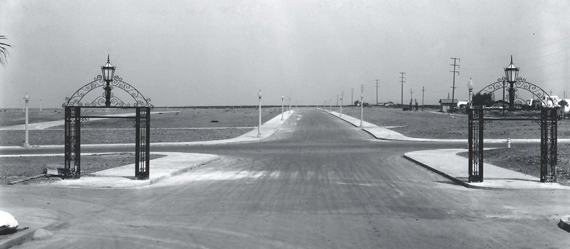
As we approach the centennial of Talmadge, I have been reflecting not only on the origins of our neighborhood but also on its remarkable rebirth at the turn of the 21st century.
Today, Talmadge is known for its charming historic homes, ornamental gates, distinctive Aegean-style streetlights, and strong sense of community. Yet by the 1990s, many of the features that once distinguished the neighborhood had deteriorated, and some were in danger of disappearing. The story of Talmadge's renewal demonstrates how historic preservation can become a catalyst for neighborhood revitalization.
In 1926, subdivision Map No. 1900 established Talmadge Park Unit 3 on the Talmadge Mesa. Two years later, in 1928, subdivision Map No. 2104 created the new neighborhood of Talmadge Park Estates. Brothers Roy and Guy Lichty developed both subdivisions and were also responsible for creating Talmadge Park Units 1 and 2 on the nearby Kensington Mesa.
The Lichty brothers were developing these communities during a period of rapid expansion in San Diego, when undeveloped mesas were being transformed into residential neighborhoods. Their developments reflected an understanding that successful subdivisions required more than houses and streets. Distinctive architecture, ornamental lighting, and impressive entrances helped establish an identity that would endure for generations. Their involvement on both mesas also helped create the lasting connection between Kensington and Talmadge.
Although geographically separated by Fairmount Canyon, the Lichty subdivisions shared a common developmental history. Each mesa, however, was given its own appearance and character.
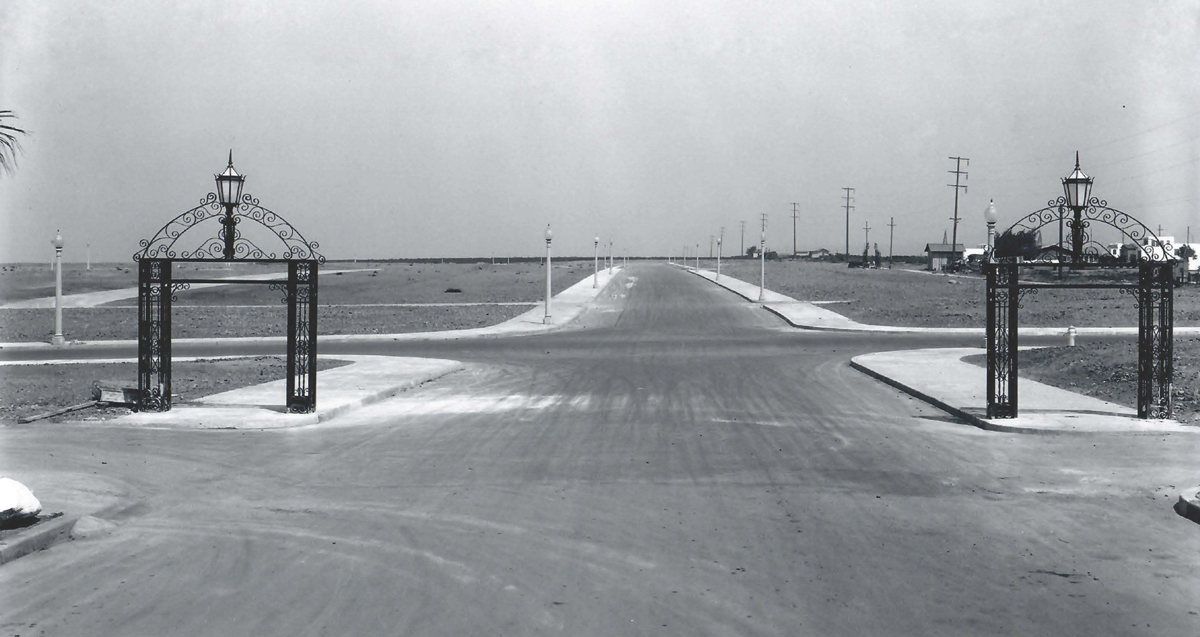
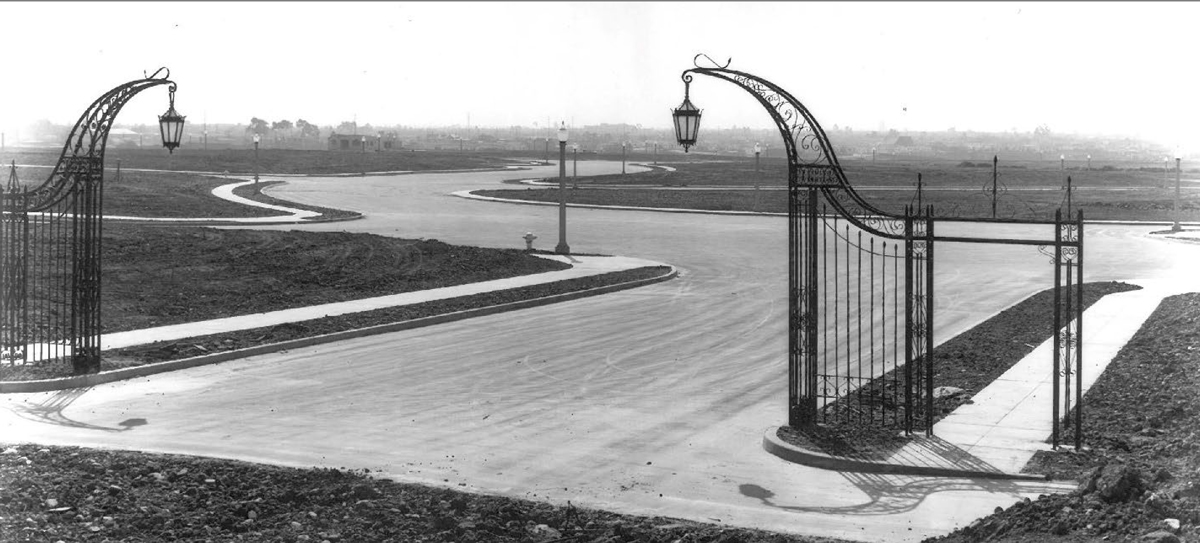
Talmadge Park Units 1 and 2 on the Kensington Mesa featured Delphi-style acorn streetlights but no gates. On the Talmadge Mesa, Talmadge Park Unit 3 and Talmadge Park Estates were distinguished by elaborate ornamental gates and elegant Aegean-style acorn streetlights. These prominent features created a unified streetscape that set Talmadge apart from surrounding neighborhoods.
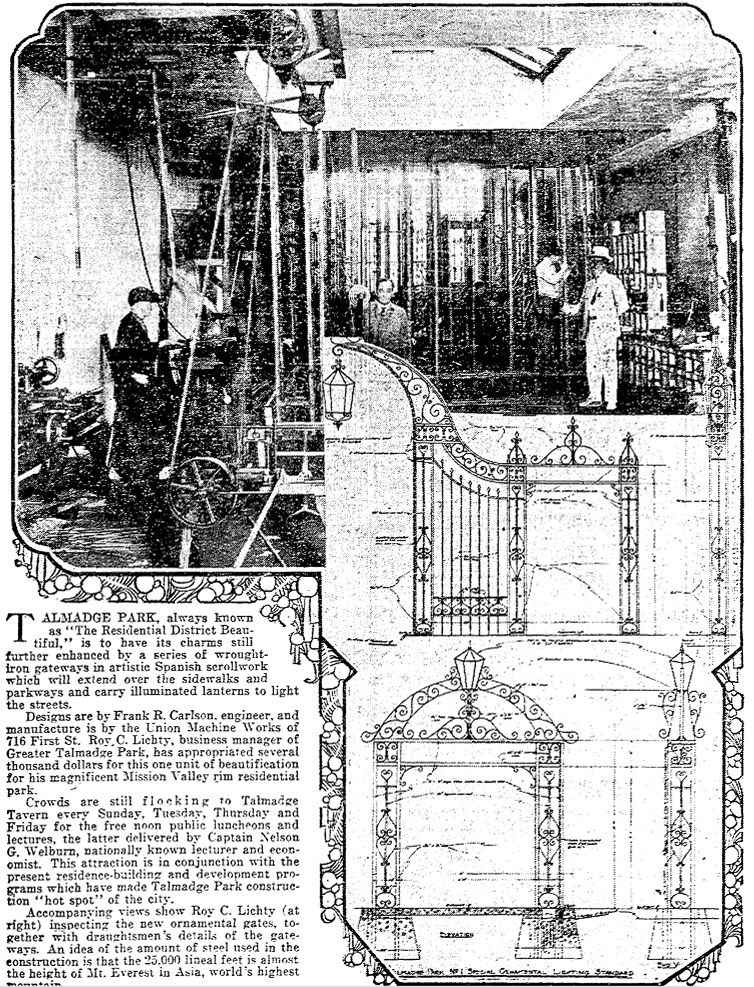
Roy Lichty was especially proud of the ornamental gates. In a May 25, 1929, San Diego Evening Tribune article, he enthusiastically promoted them. The report said the lineal footage of steel used to make them would nearly equal the height of Mount Everest.
Engineer Frank R. Carlson designed the gates' Spanish-inspired scrollwork. During their installation beginning in 1928, Carlson lived nearby at the corner of Euclid and Monroe avenues. The gates reflected the Lichty brothers' architectural ambition and became enduring symbols of Talmadge. But time was not kind to them.
By the 1990s, Talmadge looked very different from the neighborhood the Lichty brothers had created. Many homes had fallen into disrepair. Security bars covered windows, and some properties stood boarded up. The original streetlights were showing their age, and the once-grand gates were deteriorating.
The gates had become so neglected that the City of San Diego considered removing them altogether. Their demolition would have severed an important connection to the neighborhood's history and eliminated some of its most recognizable architectural features. Fortunately, two determined neighbors recognized their historic significance and began organizing to save them. Their efforts would ultimately change the course of the neighborhood.
What began as a grassroots campaign to preserve the gates led to the City of San Diego's historic designation of the Talmadge Gates Historic Corridor in 2000. The designation protected the gates and streetlights along Monroe Avenue and 49th Street, which marked the original non-canyon boundaries of the Lichty subdivisions on the Talmadge Mesa.
This preservation victory helped inspire the formation of the Talmadge Maintenance Assessment District, commonly known as TMAD. Through this district, property owners agreed to assess themselves to fund the restoration and maintenance of the gates and streetlights, along with broader neighborhood beautification projects. Rather than waiting for the City to restore these historic features, residents made a collective financial commitment to preserving them.
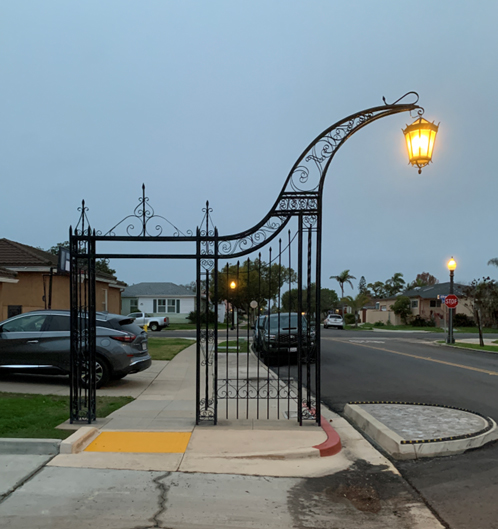
Over time, more than $1 million would be invested in restoring the gates and streetlights, including the replication of Aegean light poles that now illuminate most of the Talmadge Mesa. Each year, tens of thousands of TMAD dollars continue to support their maintenance.
Where deteriorating gates and aging streetlights had once symbolized neglect, their restoration became visible evidence of renewal. The improvements encouraged residents to take greater pride in their homes and surroundings. What began as an effort to save a collection of ornamental gates had grown into a sustained program of neighborhood improvement.
The preservation of the gates and streetlights would ultimately have significance beyond the original restoration. The boundaries established by the Talmadge Gates Historic Corridor helped define the boundaries of the Talmadge Park Estates Historic District (TPEHD), which was officially listed on the National Register of Historic Places on March 25, 2024.
Once again, Talmadge neighbors had come together, this time to document and celebrate the architectural and planning history of their community. In just two years, their collaborative efforts secured national recognition for the TPEHD, San Diego's largest historic district.
The National Register designation recognized the neighborhood's architectural and developmental significance, including its remarkable collection of modest homes constructed during the Great Depression. Among its notable architectural contributions are an early California Ranch house designed by Cliff May and San Diego's first house built with Federal Housing Administration (FHA) insured financing.
Talmadge's preservation achievements are particularly meaningful when compared with other San Diego communities. Neighborhoods such as Kensington, Loma Portal, and Hillcrest have lost many of their original ornamental streetlights. Talmadge, by contrast, has retained its historic streetlighting tradition through restoration, replication, and an ongoing commitment to maintenance.
As we celebrate Talmadge's centennial, it is fitting to recognize the generations responsible for shaping the community we enjoy today. We owe much to Roy and Guy Lichty for creating a neighborhood enriched by architectural beauty and thoughtful planning. But we also owe an enormous debt to the neighbors who, decades later, refused to let that legacy disappear, and to TMAD for sustaining their commitment to preservation.
The establishment of the historic corridor in 2000, the restoration of our landmarks, and the National Register designation in 2024 represent successive chapters in Talmadge's preservation story. What began as an effort to save a handful of deteriorating gates ultimately helped bring an entire neighborhood back to life.
Laura Henson is a retired psychotherapist whose passion for historic preservation was sparked in 2020 after attending a lecture by architectural historians Dr. Diane Kane and Priscilla Berge. She went on to play a leading role in establishing the Talmadge Park Estates Historic District, which was listed on the National Register of Historic Places in 2024. She currently serves as president of the Talmadge Historical Society, where she continues to advocate for the preservation of Talmadge's architectural heritage and neighborhood history.
BACK to table of contents
|
2026
2025
2024
2023
2022
2021
2020
2019
2018
2017
2016
2015
|