|
The Sleeping Porch
By Robin Lakin
November/December 2026
At the turn of the 20th century, fresh air was considered essential to good health, and sleeping porches became a popular feature of American homes. The Marstons, however, did not originally include one in the design of their Seventh Avenue residence, built in 1905. In 1907, they enclosed the west portion of its second floor, north-facing terrace, creating a true sleeping porch that would become a favorite retreat for their daughters.
The Marston family’s upper terrace was ideally positioned to catch the western breezes and roomy enough for cots and daybeds. Daughters Mary, Elizabeth, Harriet, and Helen flocked to this year-round place to sleep, play, and enjoy the evening air. Swaddled in nocturnal quiet (which would disappear after the Cabrillo Highway opened in 1948) and lulled by sweet birdsong, the children were intrigued by wild animal sounds. In the dead of night, they shared stories about the eerie cacophony of canyon-dwelling coyotes taunting the hyenas brought from Ocean Beach's Wonderland to Balboa Park’s adjoining mesa for the 1915 Panama-California Exposition.
A dedicated sleeping porch was not necessary to enjoy the benefits of sleeping “en plein air.” For city dwellers, even a fire escape could serve as a sleeping platform, while devices such as the Korff Sleeping Porch, a screened structure hung outside a window and advertised as “strong enough to hold a horse,” offered apartment residents an ingenious open-air alternative. Magazines of the period advised homeowners on mosquito screens, electric fans, lightweight furniture, and other ways to make these spaces comfortable.
Sleeping porches could be sparsely furnished or elaborately outfittedwith carpets, potted plants, and mirrored bureaus. Along with relief from hot summer nights, they could provide an escape from the nasal rumblings of a sibling or spouse. Upon the invention of indoor air conditioning, the screened portions of sleeping porches gradually gave way to glazed windows and added living space within the home.
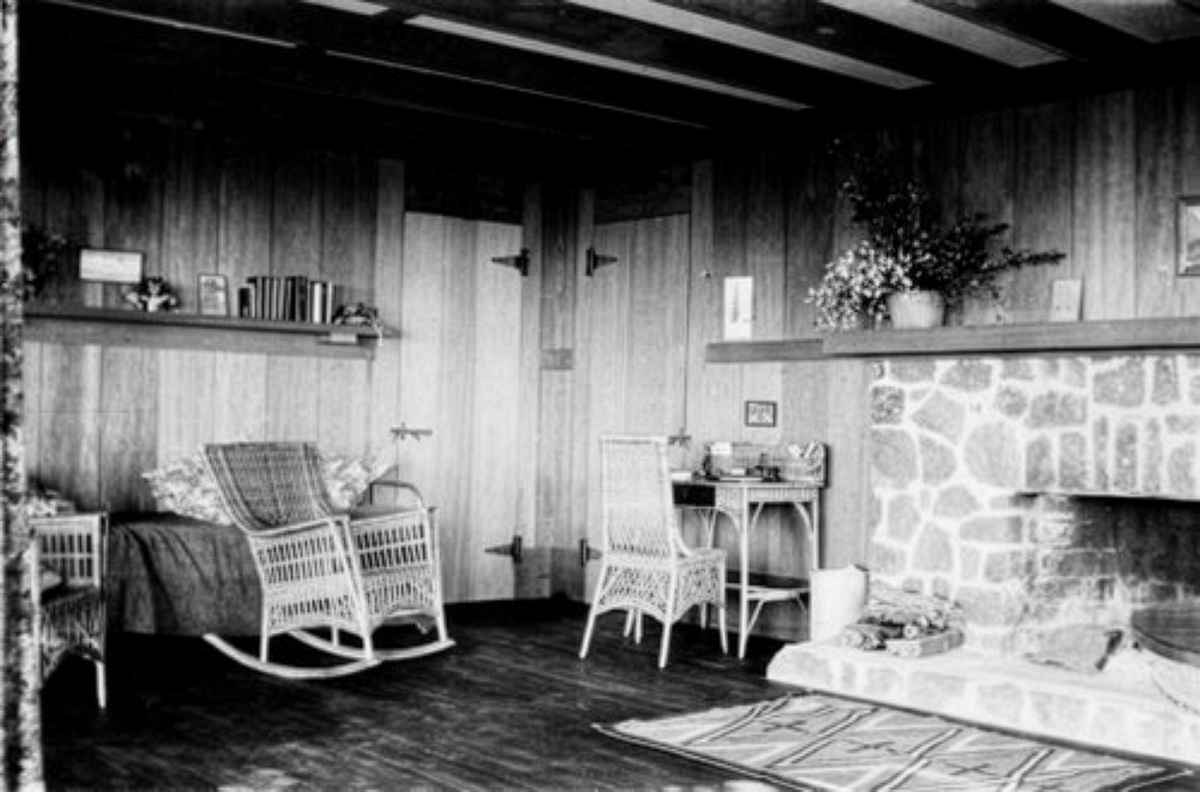
In recently reinterpreting the Marston House’s sleeping porch, SOHO’s curatorial team took cues from historic photos of the family’s Pine Hills cabin near Julian, a 1912 multi-use, multi-generational space enjoyed by George and Anna Lee, their five children, and ten grandchildren, born between 1910 and 1937.
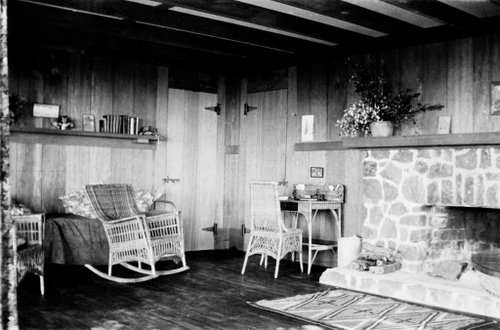 This view of the Marstons’s 1912 Pine Hills cabin, one mile southwest of Julian (no longer extant), illustrates the family’s approach to simple, rustic, outdoorsy living. A daybed set against the wall, seen just behind the rocker and adorned with floral pillows, serves as a bed and a sofa, a common dual use in cabins and sleeping porches. The cabin’s rattan furniture is similar to the San Diego Rattan Company chairs from the Ellen Sweet house now furnishing the Marston House sleeping porch. Courtesy SDHC |
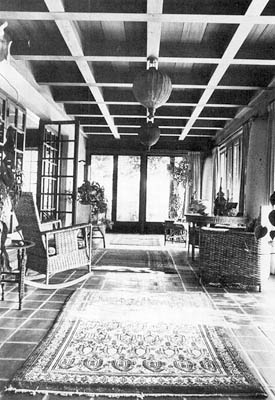 This historic image shows the solarium of the Richard Requa-designed Adelbert Sweet House on Spruce Street in San Diego. The rocking chair on the left now sits in the Marston House sleeping porch. Childhood friends Ellen Sweet and Helen Marston maintained a close relationship throughout their lives and it’s likely Helen was very accustomed to sitting on these chairs. Courtesy SDHC |
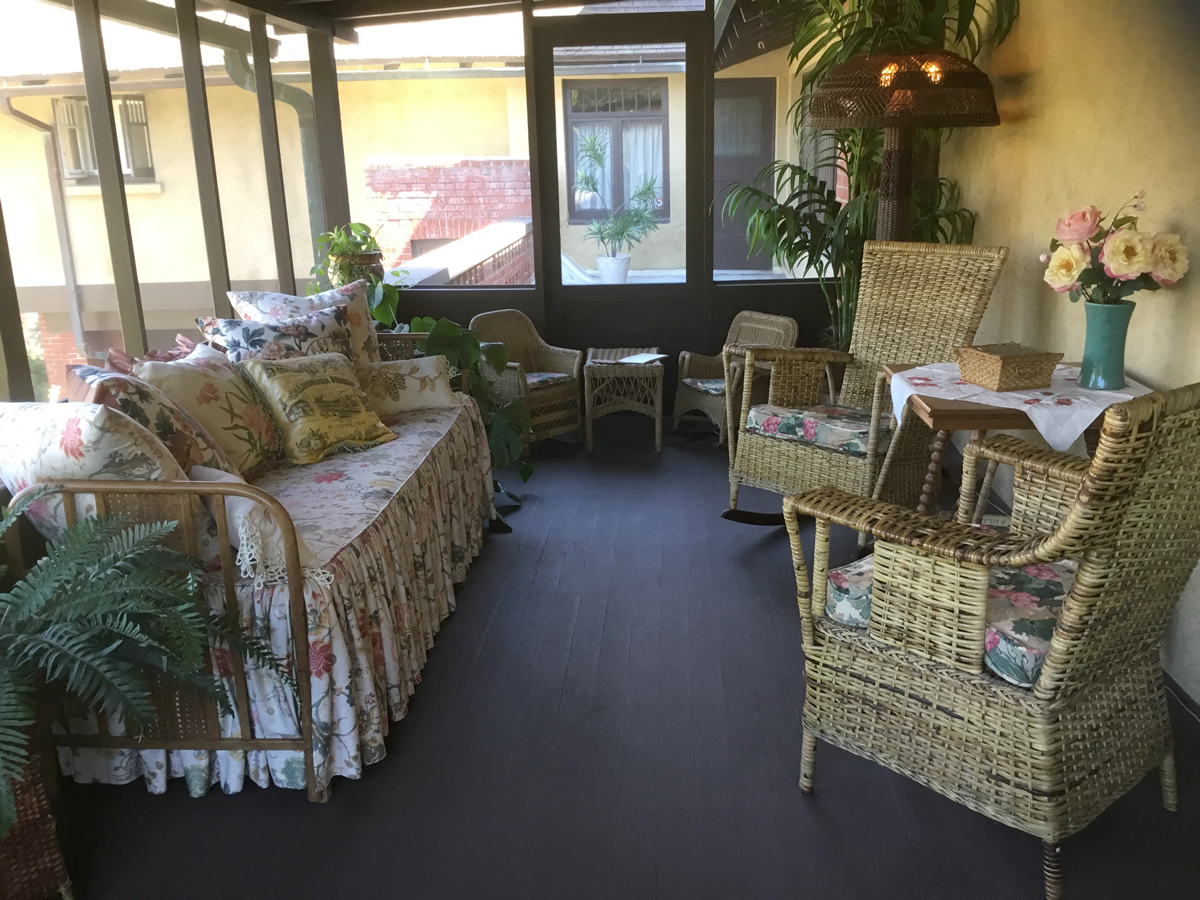
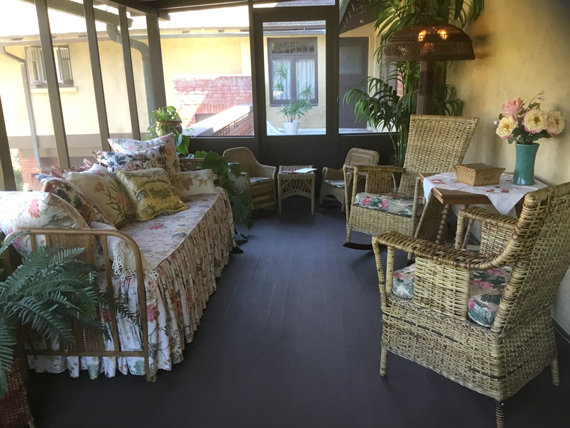 This view of the sleeping porch, looking toward the open terrace and east wing of the house features the San Diego Rattan Company chair and rocker, positioned to take in the lovely formal garden below. The lamp, with power provided from the adjacent bedroom, provides light for evening conversation, while the diminutive wicker chair and rocker create a cozy spot for grandchildren to read or play games. Courtesy SOHO collection. |
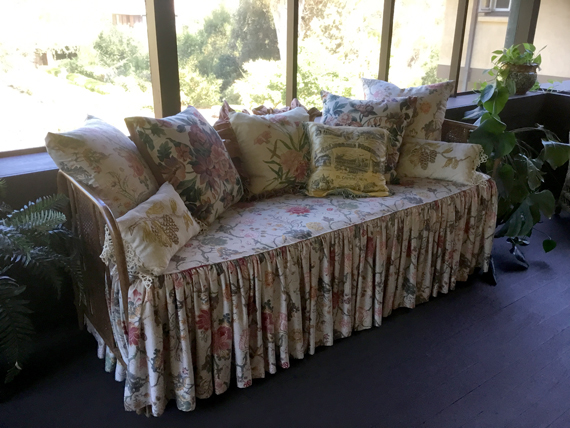 This daybed is similar to the one the Marstons used in their Pine Hills cabin, and does double duty on the sleeping porch opposite the rattan chairs. It works as a sofa for conversing, or as a resting place to lie back among the pillows with a book or perhaps to grab a cooler night’s sleep during a Santa Ana. Courtesy SOHO collection |
Arthur’s children, Hamilton, Annalee, Elsa “Doonie,” Mary, and Peter, who lived in a brick house at the north end of Seventh Avenue, were a constant presence in the Marston House’s sleeping porch, their breezy playhouse in the trees. Their cousins from other parts of California and Minnesota joined them during family visits.
Daughter Helen Marston and Ellen Sweet were close friends, travel companions, and fellow bridge players, and Helen frequently visited the 1914 Richard Requa-designed Sweet home at 435 Spruce Street in Bankers Hill. The wicker chairs in the Sweet family’s solarium were later donated to the San Diego Historical Society, now the San Diego History Center (SDHC). Given the longstanding friendship between the two women, they were likely familiar to Helen.
These chairs and other pieces, sold by the San Diego Rattan Company, spent many years on display in the Marston House sitting room. In 2023, SDHC removed them and listed them for sale at a local estate-sale warehouse.
While the sitting room’s large club chair and table sold quickly, SOHO managed to purchase the two remaining chairs. They retain their original linen cretonne-upholstered cushions, protected with new slipcovers sewn from a 1910 reproduction fabric called “Grape Trellis.” The chairs are back in the Marston House, this time in the refurbished sleeping porch.
Completing the airy space is a daybed, plants, a standing electric wicker lamp to read by, and a couple of children’s early wicker chairs. Today, the sleeping porch reflects the Marston family’s 82 years at home here while offering a timeless retreat that can be enjoyed rain or shine for contemplation, reading, conversation, tea time, or even a nap!
This portrait of the historic sleeping porch brings our year-long Inside the Marston House: Restoring a San Diego Legacy series to a close. In six installments, our research has explored the furnishings, objects, and family stories that are helping SOHO reimagine the Marston House Museum and more authentically interpret the lives of George and Anna Lee Marston and the generations of their family who lived there.
Each room in the house offers another glimpse into the Marstons’s world—and provides another reminder that restoring a historic home is about more than paint, furniture, and architectural details. It is about understanding the people who lived there and ensuring that their stories and true spirit live on within.
BACK to table of contents
Read the complete 2026 year-long series: Inside the Marston House.
|
2026
2025
2024
2023
2022
2021
2020
2019
2018
2017
2016
2015
|