|
Doña Vicenta: The Woman Who Built the Carrillo Homestead and Ranch
By Alana Coons
November/December 2026
In 1857, doña Vicenta Sepúlveda de Yorba de Carrillo arrived in the Valle de San José with her husband, José Ramón Carrillo, and their family, and built an adobe home that still stands today, thanks to the advocacy of SOHO and the wherewithal of the Vista Irrigation District. The house would later become known as the Warner–Carrillo Ranch House, a name that reflects part of the valley’s pre-Carrillo history. The story of the widely admired woman who built it, owned the surrounding land, and managed the ranch is compelling and deserves to be much better known.
Vicenta was born in Los Angeles in 1813 into a Californio family whose roots in Alta California reached back to the earliest years of Spanish settlement. Her father, Francisco Sepúlveda, had arrived in California as a six-year-old boy with his parents in 1781 on an expedition led by Captain Fernando Rivera y Moncada. Vicenta grew up in a world shaped by the missions, presidios, ranchos, and extended family networks of Spanish and Mexican California, long before the territory became part of the United States.
At 21, she married Tomás Antonio Yorba, a member of the prominent Yorba family of Rancho Santa Ana, in present-day Orange County. The couple established a household and a successful business that included ranching and a store selling imported goods, groceries, wine, brandy, hardware, hides, and tallow. They had six children, four of whom survived childhood. Their life together, however, was cut short when Tomás died in January 1845, leaving Vicenta a widow at 31.
In his will, Tomás left her an eighteen-room adobe home, substantial herds of cattle and sheep, and other property. Vicenta readily shouldered the responsibilities that came with this inheritance. She continued to manage the estate and its commercial affairs, demonstrating capabilities that impressed those who did business with her. William Heath Davis, a prominent merchant and early San Diego settler, later recalled visiting Vicenta at the Santa Ana rancho and described her as a woman who managed her property “with much ability.” He remembered her as one of his best customers, noting that in June 1846 she traveled to his vessel at San Pedro and purchased between $2,000 and $3,000 worth of goods.
 The sala, set and ready for weary and hungry stage travelers. Beginning in 1858, passengers could stop at the ranch to stretch their legs, eat a meal, and wait while the stage horses were changed. Meals served at this long table typically included beans, tortillas, and beef or mutton. This hospitality provided the family with an additional source of income. |
Davis’s account offers a glimpse of a woman moving confidently through the commercial world of early California. Vicenta was maintaining a home for her children and managing the business, negotiating purchases, directing employees, overseeing livestock, and making decisions about her property. She also well understood the value of land. In 1845, following Tomás’s death, she applied for a portion of the La Sierra lands near present-day Santa Ana under her maiden name, Sepúlveda. On June 15, 1846, Governor Pío Pico granted her the eastern half, Rancho La Sierra, in her own name.
In 1847, Vicenta married José Ramón Carrillo at Mission San Gabriel. The couple continued the family’s ranching and commercial activities at La Sierra, including the store established during her first marriage. They eventually moved to the Valle de San José for new opportunities for ranching and trade. They had nine children together, eight of whom survived childhood, bringing the number of Vicenta’s surviving children from both marriages to twelve.
The original Carrillo adobe was built in 1857, beginning as a modest two-room structure with a living room, or sala, and a bedroom, or dormitorio. Verandas ran along the north and south sides, and the family later enclosed them to create additional rooms. The house grew with the needs of a large family and a busy ranching enterprise. In 1858, Vicenta applied for and received title to four square leagues of the Valle de San José, approximately 17,714 acres, from Silvestre de Portilla. The land and the house were hers, and the ranch became a complex working operation.
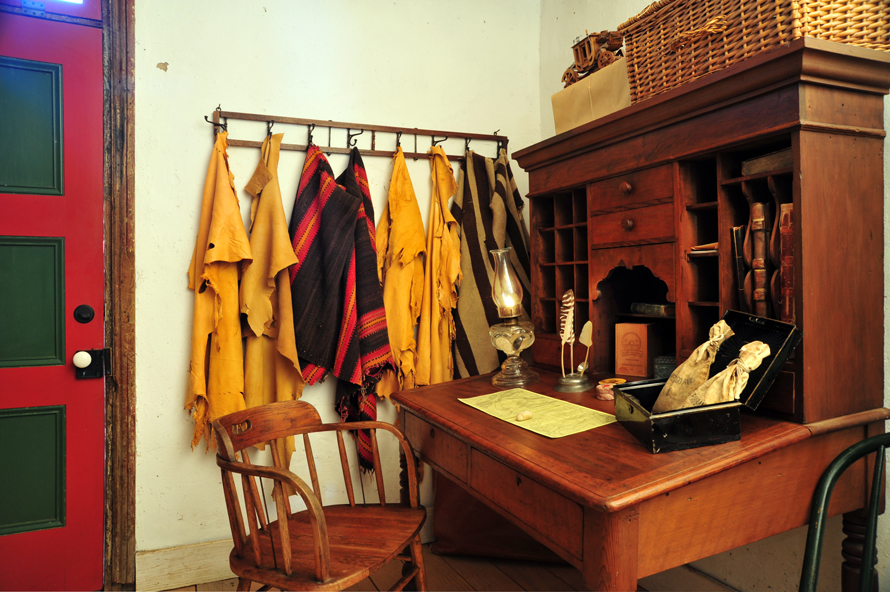 The stage and postmaster's station, as it appears today, was once a swing station on the Butterfield Overland Mail route. In 1858, Vicenta Sepúlveda de Carrillo secured the contract to operate the station, welcoming thousands of travelers crossing the Southern Emigrant Trail. |
 The Warner–Carrillo Ranch served not only as a stage station but also as a place of commerce for travelers and the surrounding community. The trading post’s story offers another glimpse into the ranch’s role in the region’s early history. All photos by Sandé Lollis |
The valley’s position along the Southern Emigrant Trail made it a natural stopping place for travelers crossing the deserts between the Midwest and California. Recognizing the commercial possibilities, Vicenta sought and secured a contract with John Butterfield to operate the ranch as a swing station on the Overland Mail route. This brought a steady flow of travelers and emigrants to California and made the ranch an important part of the region’s social, transportation, and communications history.
However, ranching remained the heart of the enterprise. The family raised cattle, sheep, horses, pigs, and goats and cultivated wheat, barley, and hay. Vicenta supervised the ranch with the assistance of her children and the people she employed, primarily Native Americans who worked and lived at the ranch. Her relationship with these workers reminds us that the story of rancho life was not simply one of prosperous landowners and enterprises they could take for granted. Native American labor was essential to the success of many Californio ranchos.
During the smallpox epidemic of 1862–1863, Vicenta turned the large adobe barn near the house into a makeshift hospital for Cupeño and Kumeyaay workers and their families who had fallen ill. She personally tended to scores of sick people during an epidemic that devastated Native American communities throughout Southern California.
This episode adds another dimension to her story and personal involvement in the lives of the people who lived and worked on the ranch. The history of these ranchos cannot be understood through the achievements of their landowners alone. It must include the Native people whose labor sustained them and whose lives were profoundly affected by the epidemics and inequalities of nineteenth-century California.
In 1864, tragedy struck when José Ramón Carrillo was ambushed and murdered. Widowed for the second time, Vicenta had a large family to care for and a substantial ranch to manage, and she remained in the Valle de San José, continuing the ranching and commercial operations with help from her eldest son, José Antonio Yorba. Records from the late 1860s show that the ranch was still producing, with assets of hundreds of sheep as well as cattle, horses, and other livestock.
One fascinating account of Vicenta comes from Davis, the San Diego pioneer and merchant, who described an exceptional visit to Rancho Santa Ana. Preparing to cross the swollen Santa Ana River after days of rain, Davis and his companions faced a dangerous passage. Vicenta ordered her mayordomo to gather several herds of horses and directed the ranch’s vaqueros to drive the animals across the river and back again. Their movement trampled and hardened the riverbed’s soft sediment, making the crossing safer. When the work was done, Vicenta informed Davis that the river was ready for them. This remarkable story captures her practical knowledge of the land and animals, her ability to assess a problem, and the authority with which she directed those around her. Davis admired her beauty and elegance, but this anecdote also makes clear that she possessed the experience and judgment to manage a substantial rancho.
Vicenta’s lifetime encompassed a profound transformation in California. Born under Spanish rule, she came of age during the Mexican era and lived through the transfer of California to the United States, the arrival of new settlers, and the changes in law and commerce that reshaped the rancho world. As a Californio woman, she occupied a particular place in that history, one formed by family inheritance, landholding, marriage, business, and community obligations. Her experiences complicate any simple picture of nineteenth-century women as being confined to domestic life.
Historic places are often our most direct connection to people whose lives have faded from public memory. Their buildings, landscapes, and surviving records allow us to recover stories that a more familiar name or a conventional account can obscure. At the Warner–Carrillo adobe, looking more closely at the house means looking more closely at Vicenta Sepúlveda de Yorba de Carrillo, whose wise decisions shaped this place.
Historic sites also require use and visitation to keep the doors open. Please make visiting SOHO’s Warner–Carrillo Ranch House a priority the next time you're headed for the backcountry. It’s open Saturdays and Sundays from 12pm to 4pm, or by appointment during the week for group tours, car clubs, and special events. Our acclaimed storyteller and head docent, Kathryn Fletcher, will be waiting for you. For visiting information, call (619) 297-9327 or explore the Warner–Carrillo Ranch House and group tour pages on SOHO’s website.
BACK to table of contents
Read the rest of the ongoing The Marstons: A California Story History Series.
|
2026
2025
2024
2023
2022
2021
2020
2019
2018
2017
2016
2015
|