|
ACTION ALERT
Tell Congress: Protect the Federal Law That Gives Communities a Voice
in Saving Historic Places. Section 106 Is Under Attack
September/October 2026
One of our nation's most important historic preservation protections is under attack, and, if successful, the consequences would threaten, harm, and even erase historic buildings, neighborhoods, archaeological sites, cultural landscapes, and Tribal cultural resources across the country.
On July 24, 2026, the Advisory Council on Historic Preservation (ACHP) in Washington, D.C. voted to move forward with a sweeping rewrite of the regulations implementing Section 106 of the National Historic Preservation Act of 1966. The proposed changes would fundamentally weaken the federal historic preservation review process of federal projects by narrowing what can qualify for protection, reducing or eliminating public participation, diminishing consultation, and giving federal officials and agencies substantially greater discretion over whether and how historic resources are considered and treated.
The draft rule is now moving through federal review before it is published in the Federal Register. Once published, the public will have a finite period to submit formal comments to Congress, federal agencies, the ACHP, and others.
SOHO is hardly alone in our belief that these changes would gut one of the most important tools Americans possess to protect the historic places that tell our nation's story.
Section 106 does not require the government to stop a project. It requires federal agencies to consider the effects of their proposed actions on historic sites and properties before making a final decision and provides an opportunity for states, Tribes, local governments, preservation organizations, and the public to participate in the discussion and evaluation.
The process exists because once a historic place is destroyed, its history cannot be restored.
Section 106 has never guaranteed that a historic place will be saved or that a project will be halted. It guarantees something more fundamental: Before the federal government can legally act, it must follow a specific process for understanding what is at risk, hear from the people who care and know about the building or place in question, and consider whether damage can be avoided, minimized, or mitigated.
That is not obstruction. It is responsible stewardship.
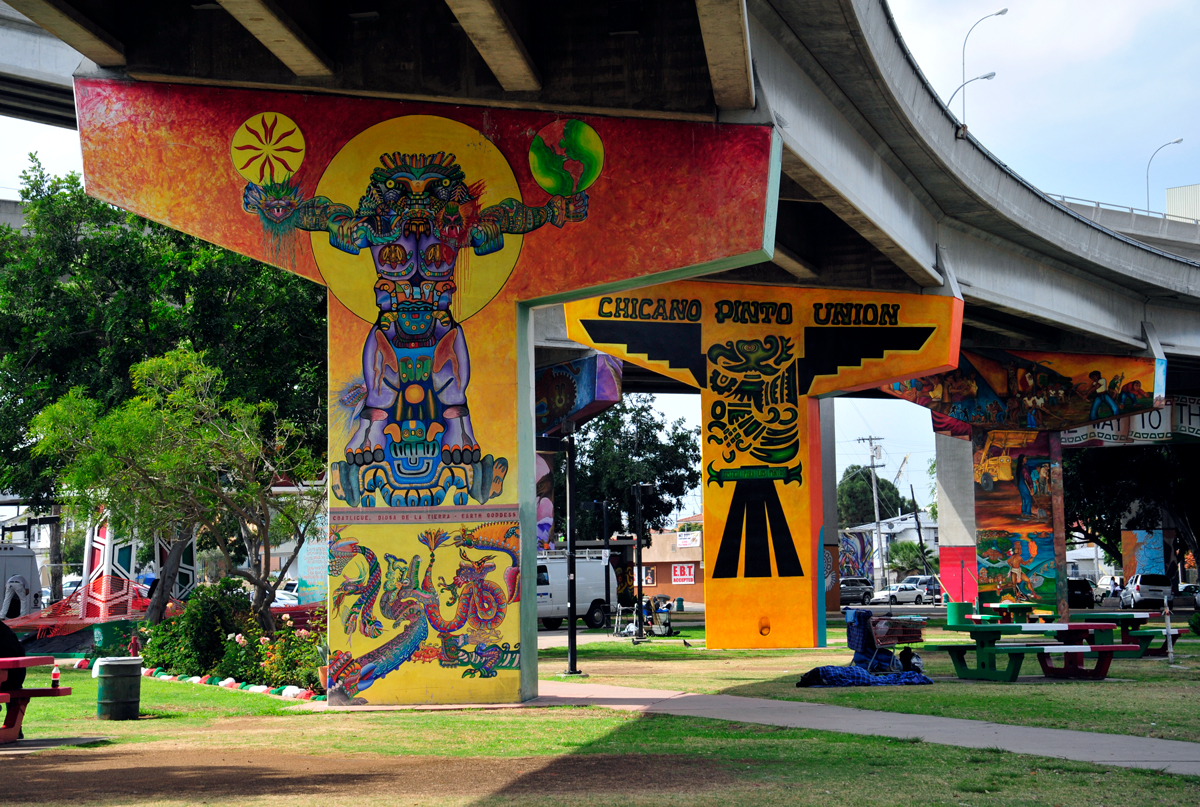
 Section 106 became an important tool in protecting the Chicano Park’s nationally significant murals. Its regulatory framework required agencies such as Caltrans to work with community groups and preservationists to help protect and restore the murals during subsequent state infrastructure and bridge-retrofitting projects. Photo by Sandé Lollis |
What's at Stake?
The National Trust for Historic Preservation has identified several of the most disturbing provisions in the proposed rewrite:
- Federal agencies would no longer be required to try to avoid or minimize damage to historic places. The proposed revisions would eliminate the longstanding requirement to avoid, minimize, or mitigate adverse effects and replace it with a substantially weaker standard, requiring only “reasonable efforts” to identify “reasonable mitigation measures.”
- State and local governments would lose their right to be notified and to comment when federal projects threaten historic places in their jurisdictions. This would strip communities of a critical opportunity to participate before irreplaceable resources are damaged or destroyed.
- Public participation would become entirely optional. Rather than recognizing the public's views as essential to informed federal decision-making, the proposed regulations would give federal agencies exclusive discretion to determine whether public participation is useful. A mandatory consultative process would become a one-way conversation in which the government decides whether it wants to hear from the people affected.
- Federal agencies would no longer be required to consult with Tribal communities or seek their expertise regarding significant cultural resources. This is an especially serious threat to places whose importance is rooted in Indigenous history, sacred and cultural traditions, and continuing relationships to the land.
- Significant cultural landscapes would simply cease to qualify as historic properties. The proposed regulations would exclude noncompact topological and unimproved natural features—such as mountains, valleys, bodies of water, and landscapes, including ethnographic landscapes—from consideration under Section 106. That would place culturally significant landscapes at extraordinary risk, including places like the Grand Canyon and other landscapes whose historic and cultural significance cannot be separated from the land itself.
- Federal agencies would no longer have to consider the reasonably foreseeable consequences of their actions on historic sites and properties except where those actions directly and physically damage the property. This would dramatically narrow the scope of review and ignore the foreseeable negative impacts that major federal projects can have on historic places.
- The proposed regulations have also been challenged as inconsistent with the National Historic Preservation Act and with the ACHP's own rules and procedures. Preservation organizations have raised serious concerns about whether the American Council on Historic Preservation is following the requirements governing its own rulemaking process.
- The proposed revisions are internally inconsistent and contain significant errors and ambiguities. Rather than providing the clarity and efficiency that supporters of the rewrite claim to seek, the changes would create enormous regulatory confusion and uncertainty for federal agencies, preservation professionals, communities, Tribes, and property owners.
Why This Matters
The National Historic Preservation Act was enacted in 1966 in response to the nationwide, wholesale destruction of historic buildings, neighborhoods, and cultural resources during an era of massive urban renewal and highway construction.
Section 106 was created so that our heritage and history would not have to pay that price again. For nearly six decades, it has provided a mechanism for preservationists, communities, Tribal Nations, state and local governments, and federal agencies to sit at the same table and find better solutions.
Modernizing a process is very different from dismantling its fundamental protections. Drastically weakening Section 106, as proposed, does not simply reduce regulation. It shifts power away from the American people and toward federal officials and agencies and the powerful interests behind major infrastructure, energy, information technology, telecommunications, mining, and development projects.
This Affects San Diego, Too.
SOHO Executive Director Bruce Coons explains why the proposed changes threaten one of the nation's most important preservation protections and why the fight over Section 106 matters here in San Diego and across the country. See Bruce Coons' Op-Ed.
San Diego County is filled with places where protection can depend upon federal review—from historic buildings and districts to archaeological sites, cultural landscapes, military and transportation resources, and places of profound importance to Indigenous communities.
The proposed changes would affect how such places are identified, evaluated, consulted upon, and protected whenever federal funding, approvals, permits, licenses, or other federal involvement brings Section 106 into play.
Once these places are destroyed, no regulation can bring them back.
TAKE ACTION NOW
SOHO joins the National Trust for Historic Preservation and preservation organizations across California and the country in mobilizing a nationwide response and asking Americans to contact their Congressional representatives.
1. Contact Your Members of Congress
Ask your U.S. Senators and Representative to oppose the proposed weakening of Section 106 and to defend the integrity of the National Historic Preservation Act.
The National Trust's action campaign provides a simple way to send a message directly to your Senators and your U.S. Representative.
To write the governor.
2. Watch for the Federal Register Comment Period
The proposed rule has not yet been formally published in the Federal Register. Once it is published, a formal public comment period will open.
SOHO will alert our members when comments can officially be submitted. We are informing you about it now because the attack on Section 106 is extremely dangerous and complex.
3. Share This Alert
The preservation community is working to generate a massive nationwide response. Please send this information to friends, neighbors, colleagues, local officials, Tribal and cultural organizations, and anyone who cares about America's historic places.
The National Trust is seeking 250,000 letters from Americans urging Congress to protect Section 106. Please do your part using their link above for easy messaging.
We cannot let preservation become an aspect of our lives the government can simply choose to ignore. Protect the law. Protect the process. Protect our heritage.
TAKE ACTION NOW
BACK to table of contents
|
2026
2025
2024
2023
2022
2021
2020
2019
2018
2017
2016
2015
|