|
National Park Service Advances Plan for
Butterfield Overland National Historic Trail
July/August 2026
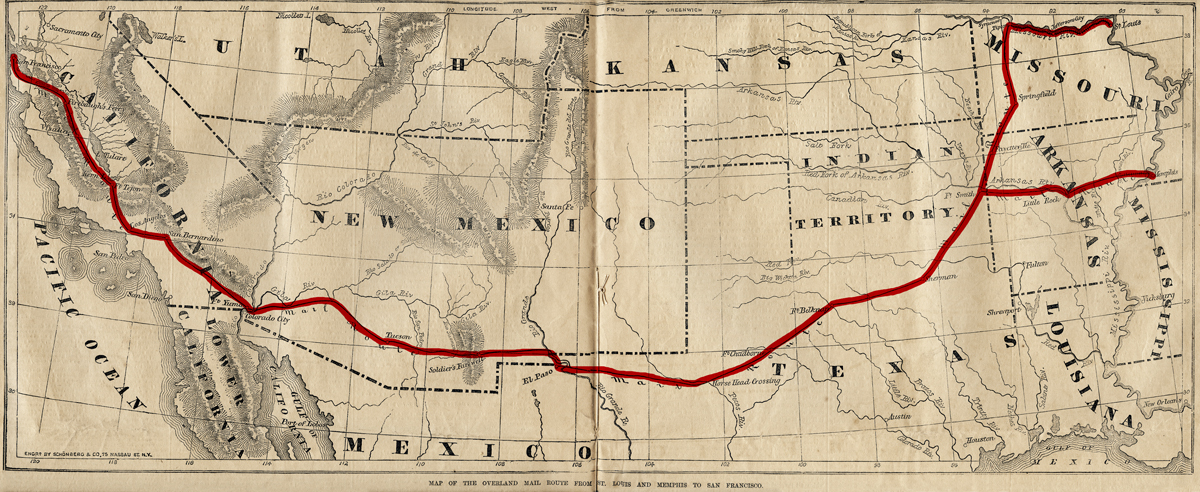
 Map of the Overland Mail route from St. Louis and Memphis to San Francisco. The route extended 2,800 miles and was the longest stage line in the world. The middle portion, approximately 1,100 miles, crossed the Chihuahua, Sonora, and Colorado deserts. Courtesy New York Public Library archives
The National Park Service is developing a draft comprehensive plan for the Butterfield Overland National Historic Trail, an important initiative that will guide the preservation, interpretation, and management of one of the nation's most significant historic transportation corridors.
Stretching across the American Southwest, the Butterfield Overland Trail commemorates the route of the Butterfield Overland Mail, the nation's first regular transcontinental stagecoach service. Operating between 1858 and 1861, the route connected St. Louis and San Francisco, carrying passengers, mail, and news across a rapidly expanding nation. The trail also incorporates the history of the Southern Emigrant Trail, used by thousands of travelers journeying west to California.
The proposed plan establishes a long-term vision for protecting historic trail resources, improving public access and interpretation, strengthening partnerships, and helping future generations understand the people, cultures, and events that shaped the American West.
For San Diego County, the plan has particular significance because one of the most important surviving resources associated with both the Southern Emigrant Trail and the Butterfield Overland Mail is in Warner Springs. The Warner–Carrillo Ranch House, built in 1857 by rancher Vicenta Carrillo, served as a stage station on the Butterfield route and remains one of the most intact historic sites associated with 19th-century overland travel in California.
Today, visitors to the National Historic Landmark can still experience much of the same landscape encountered by emigrants and stagecoach passengers more than 160 years ago. The adobe ranch house, its historic setting, and the surrounding open space provide a rare opportunity to understand the challenges and rewards of travel across the Southwest during a transformative period in American history.
The National Park Service's planning effort also recognizes the many stories connected to the trail, including Native American history, Mexican-era California, westward migration, transportation, communication, and the development of ranching communities throughout the region.
SOHO has submitted comments supporting the draft plan and encouraging recognition of the Warner–Carrillo Ranch House as one of the premier interpretive destinations along the national historic trail. As planning moves forward, we look forward to continued collaboration with the National Park Service and other partners to preserve and share this important site and its role in our nation's history.
BACK to table of contents
|
2026
2025
2024
2023
2022
2021
2020
2019
2018
2017
2016
2015
|