|
Protecting Historic Warner Springs
By Kathryn Fletcher
July/August 2025
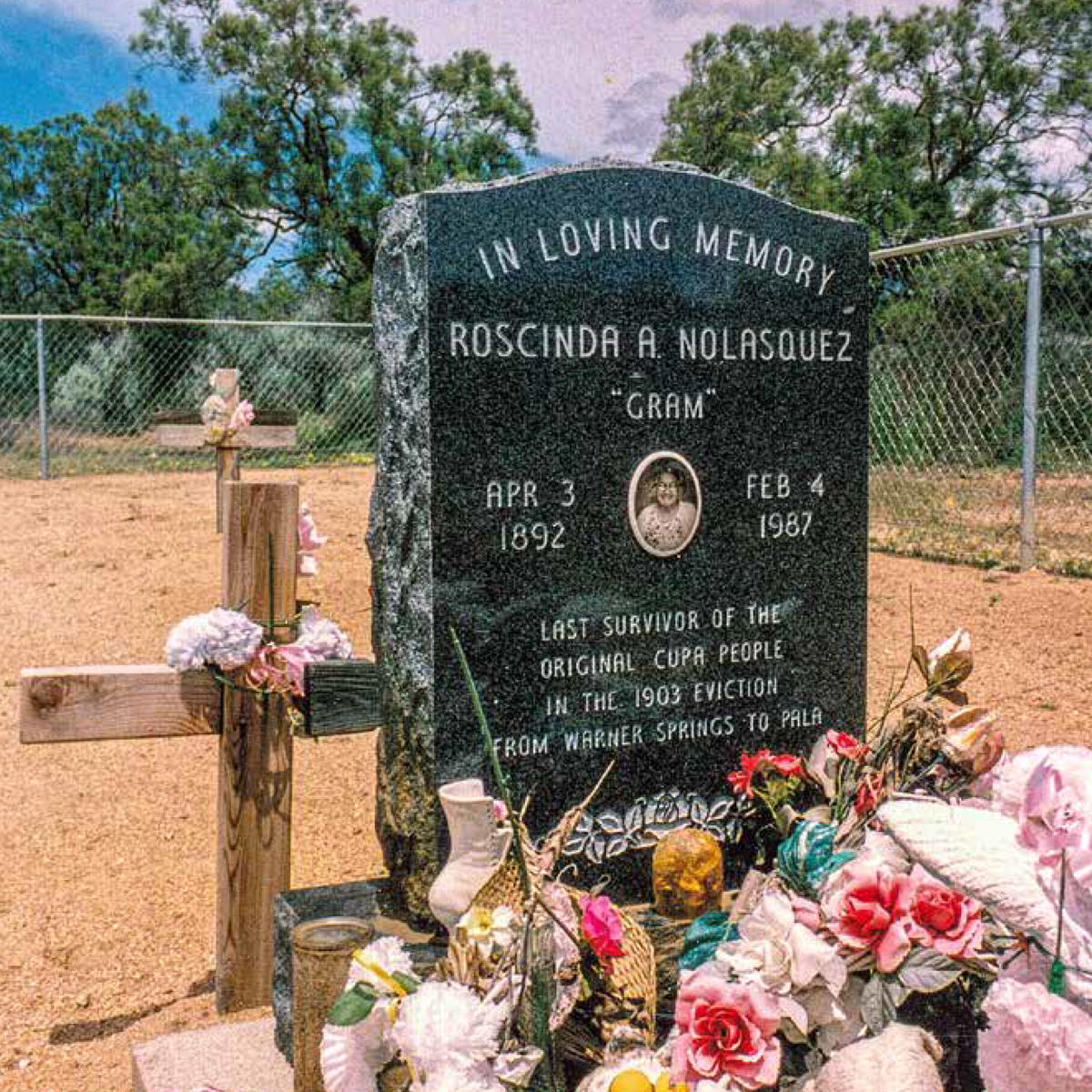
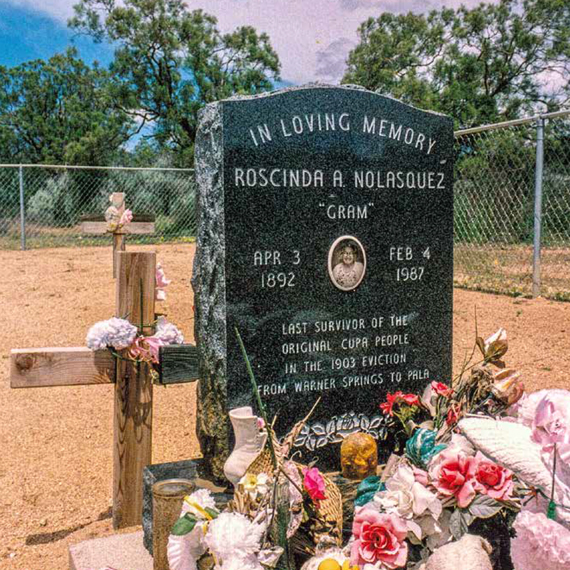 Roscinda A. Nolásquez was the last Cupeño survivor of the tribe’s 1903 “Trail of Tears” removal from Warner Springs. This photo of her grave marker, located in the cemetery behind the 1830 Chapel of St. Francis of Assisi, appeared on the cover of The Journal of San Diego History, Winter 2018. |
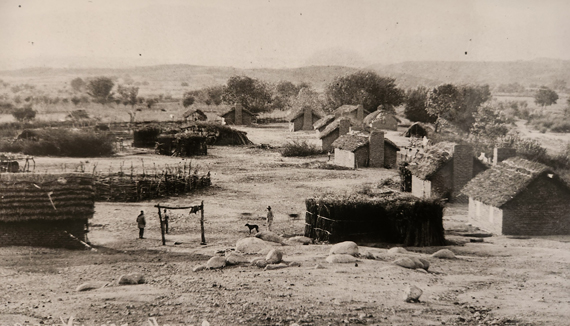 The Cupa village in 1893, a decade before the “Trail of Tears” eviction. Photos courtesy San Diego History Center |
Editor’s note: Kathryn Fletcher chairs the Warner Springs Community Sponsor Group, wrote the Arcadia Publishing book Warner Hot Springs, and works as head docent and manager of SOHO’s Warner-Carrillo Ranch House Museum, among other activities and ties to Warner Springs.
Not far from the Warner-Carrillo Ranch House is a place dear to the hearts of many San Diegans—the Warner Hot Springs Resort, now known as Warner Springs Ranch Resort.
During the past 175 years, many people have owned the famed hot mineral springs and the surrounding lands. The indigenous Cupa Indians lived here since at least 1795, and later, the William Henshaw family followed, from 1911 to 1975.
The resort property includes the original early 19th-century Cupa Native American village of 17 adobe homes. The settlement, also called Agua Caliente by the Spanish or Warner Hot Springs, it was the primary residence of the Cupa. As one of the most, if not the most, intact early 19th-century Native American villages in the nation, it is extremely rare. In addition, the residents' intermarriage among the Luiseño, Diegueño, and Cahuilla people helped create the Cupeño cultural heritage, which is among the richest of California tribes.
The original village was set ablaze in retaliation for the Garra Raid of 1851, in which cattleman John Warner's house and trading post, north of the Warner-Carrillo Ranch House, were attacked and burned by the Cupa and William Marshall, Warner’s foreman, who had several possible motives for betraying his boss. The uprising was a response to the imposition of a state tax on cattle and other livestock owned by the Indians. The Cupa rebuilt their destroyed homes near the hot springs using adobe construction they had learned from the Catholic missionaries. (At other times, the Cupa and white settlers lived peaceably.)
The village was tragically abandoned in 1903, when the Cupa people were forcibly removed to the Pala Reservation, approximately 40 miles away. The eviction followed a U.S. Supreme Court decision in favor of the heirs of former California governor John Downey, who then owned the Warner Springs land grant.
In 1983, the late historian Phil Brigandi conducted an oral interview with Roscinda A. Nolásquez, then the last living Cupa survivor of the 1903 “Trail of Tears” eviction. You can read her account of the removal online. (Scroll past the historic photographs to pages 42-49.)
Nolásquez (1892-1987) helped Brigandi draw a map of the village and identify the families who lived there. She is buried nearby in the cemetery behind the 1830 Chapel of St. Francis of Assisi; her gravestone bears her smiling photo below the engraved nickname "Gram." To learn more, read Brigandi's article online.
During the property's notable Henshaw ownership, generations of families enjoyed what was turned into a 2,500-acre resort—playing golf and tennis, riding horses, hiking, and, of course, soaking in the naturally beneficial hot spring pools and spa. Even today, this relatively unchanged sweeping landscape of valley and mountains may be one of Southern California's most beautiful countrysides. Fast forward to 2013, when the resort was purchased in bankruptcy court by Pacific Hospitality Group of San Diego.
Regrettably, Warner Springs Ranch Resort has been closed since then, and tribal members, preservationists, history lovers, and many others continue to hope that its historic resources have not been demolished or damaged by neglect. Now, a large-scale development has been proposed for the site, which would include 685 homes, a large RV park, and an additional nine-hole golf course, among other things.
Several years ago, the San Diego Board of Supervisors formed the Warner Springs Community Sponsor Group to study and advise the county on this proposed project and other discretionary land planning projects within the Warner Springs boundaries. Public meetings are held the third Thursday of the month at the Warner Springs Community Resource Center. Find the committee’s agendas and minutes on the county's website.
After several extensions from the San Diego County Planning and Development Department, reports evaluating this large residential and recreational development proposal may be nearing completion. There are many aspects to consider, including the California Environmental Quality Act, projected traffic and vehicle miles traveled, fire hazards and any resulting new building codes and insurance requirements, noise and light pollution, and water supply. Last but not least, officials must review the rare Native American sites and the resort’s remaining historic buildings regarding the proposed project’s impacts.
Before the Board of Supervisors makes a final decision, county officials will hold a public meeting so that San Diegans can consider the proposed development and provide feedback. After the reports are submitted to County Planning and Development, staff will review them and make recommendations to the Planning Commission, and eventually, if the project advances, to the Board of Superiors.
In addition, the Sponsor Group strongly urges the County Historic Site Board to review the project and forward its recommendations to the Planning Commission.
The group has studied in detail the 2011 General Plan for the North County and the 40-year-old Specific Plan Amendment still in use, and it has requested a new Specific Area Plan for Warner Springs, as much has changed in the last four decades.
As already noted, the original Cupa village is one of the most intact early 19th-century Native American sites in all of the country, let alone in San Diego County. The Sponsor Group urges SOHO members and the public to contact the Board of Supervisors and emphasize the rarity of the village and other historic resources on this property. When the proposed development is discussed, we want the decision makers to fully understand and recognize the public's countywide concern and support for preservation and protection of this important site.
Resources
BACK to table of contents
|
2026
2025
2024
2023
2022
2021
2020
2019
2018
2017
2016
2015
|