|
Gathering by the Hearth: Restoring the Spirit of the Marstons’ Living Room
By Robin Lakin
May/June 2026
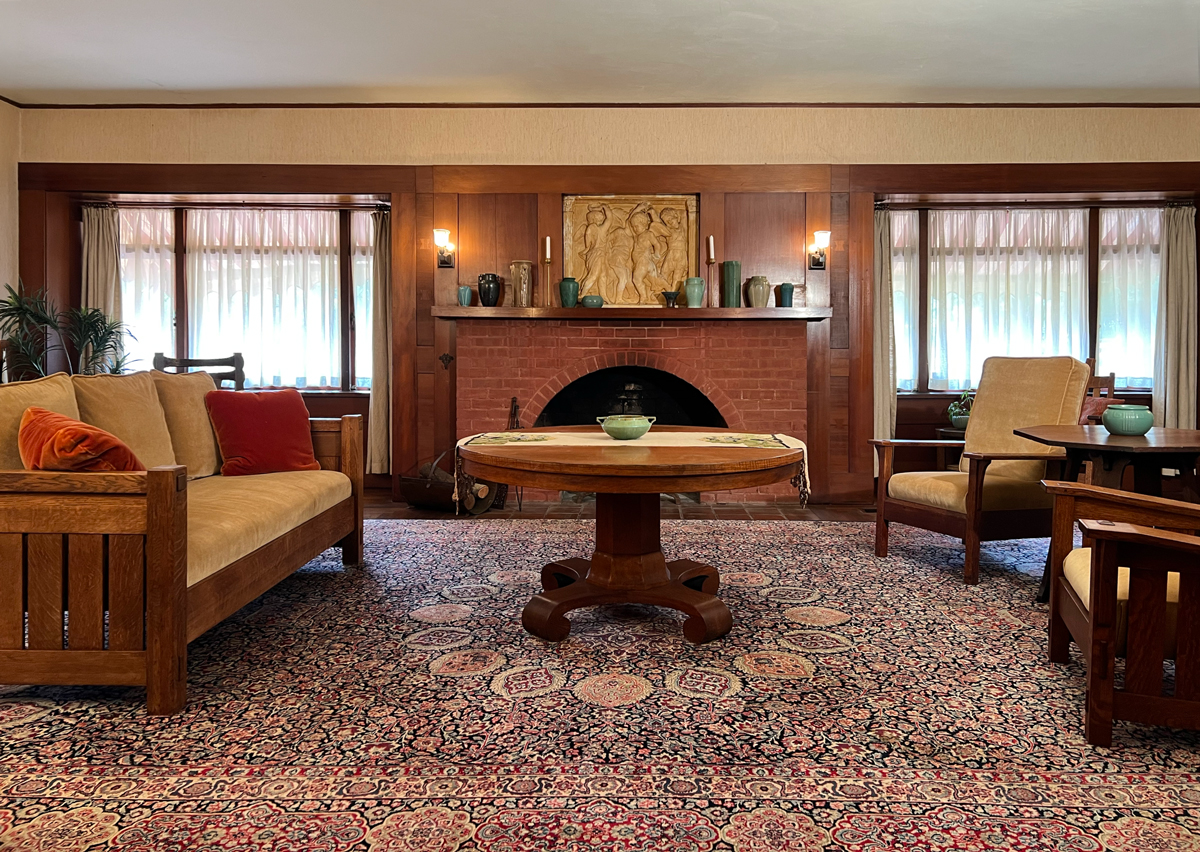
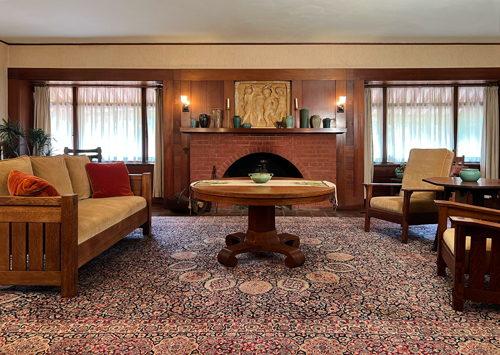 A selection of Arts and Crafts era pottery highlights the living room fireplace mantle along with a plaster copy of Donatello's Dancing Putti. The graceful lines of the Berkey & Gay Marston family table, where plans for the 1915 Panama–California Exposition took shape, provide the centerpiece of the living room, recently reinterpreted by SOHO. |
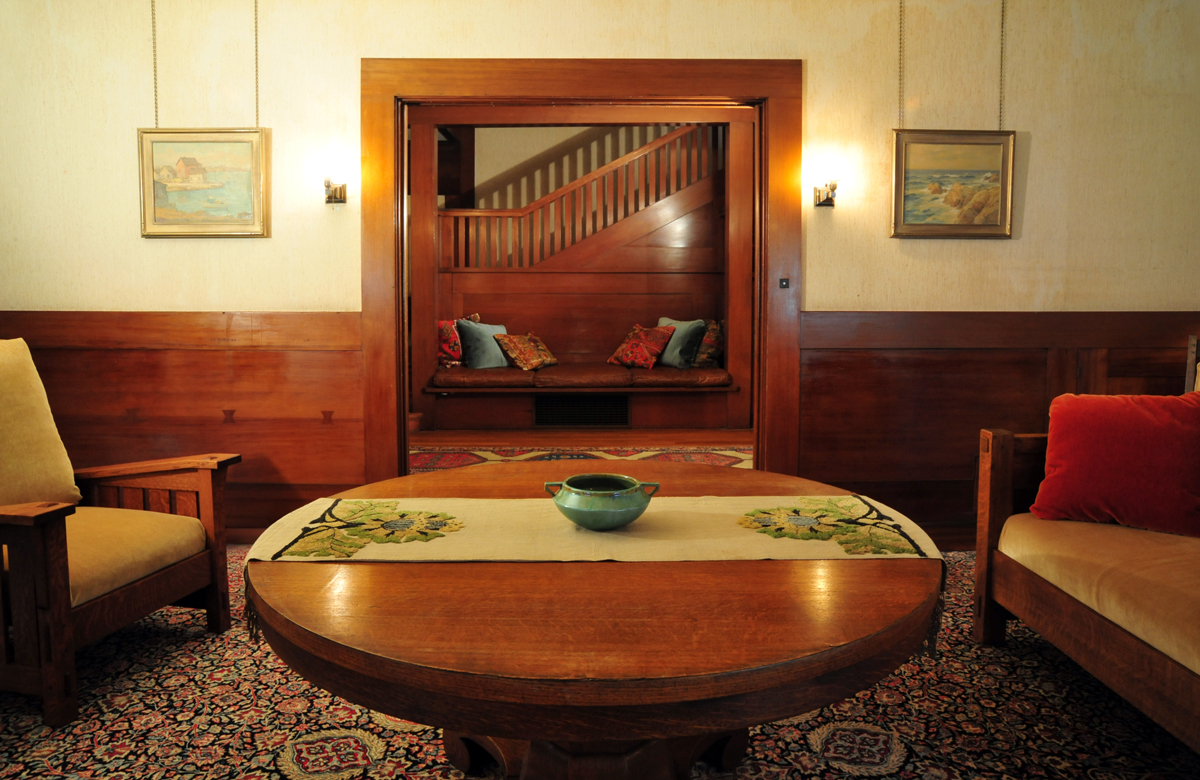
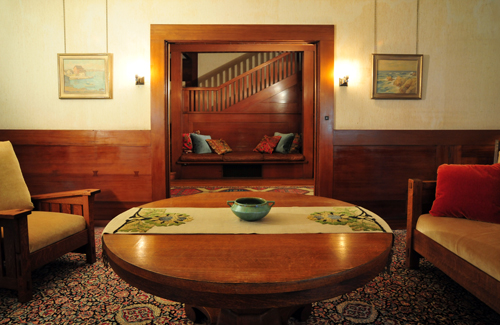 Two waterscape paintings by renowned San Diego plein-air artist Maurice Braun flank the view from the living room into the hallway, where a redwood inglenook, designed as a reception area for guests, was built into the main staircase. |
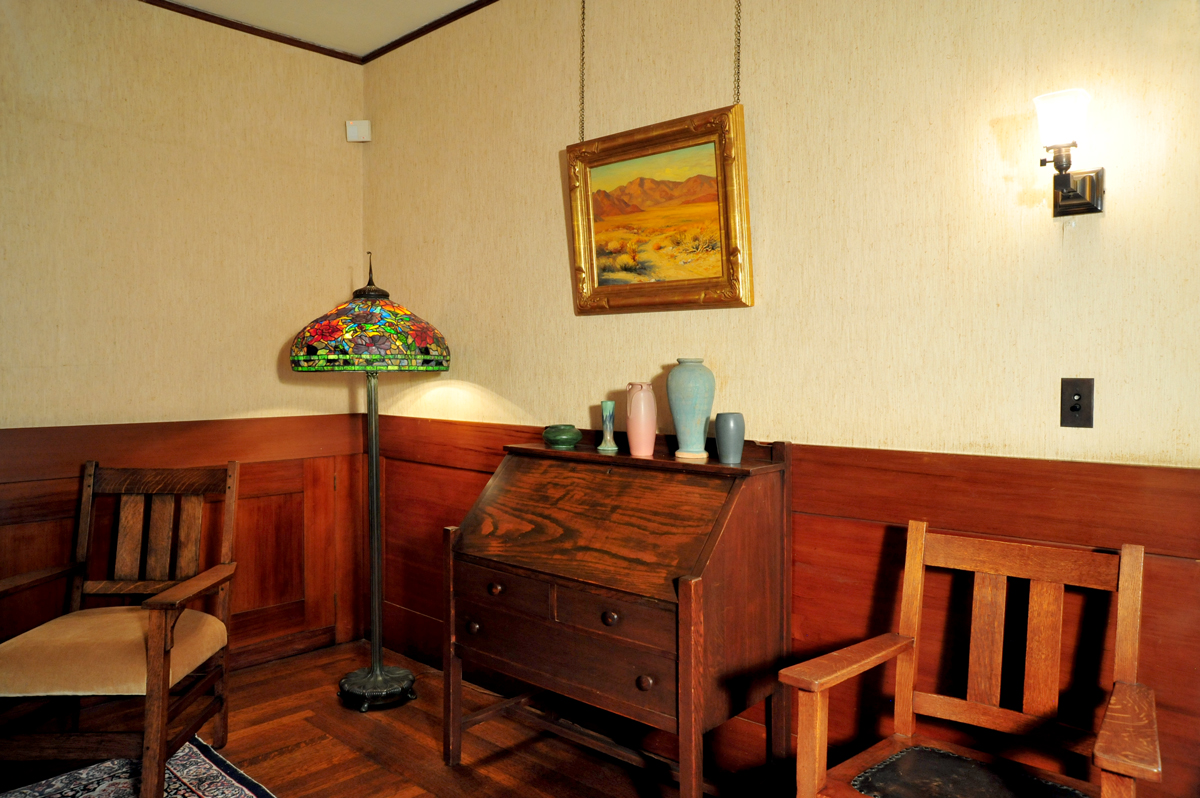
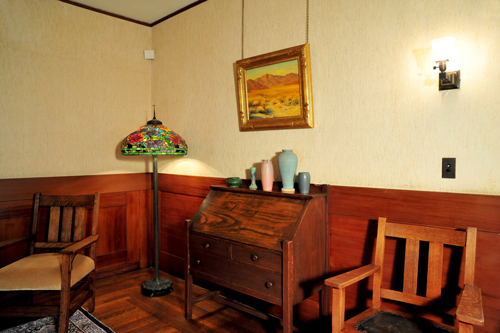 A quiet corner of the living room showcases an original standing Tiffany lamp in the peony pattern, designed by Clara Wolcott Driscoll. The stained-glass lamp's stunning hues pick up the tones of the majestic Anza-Borrego Desert, painted by Alfred Mitchell, another leading San Diego artist and a friend of the Marstons. This painting is particularly meaningful, as the desert, in San Diego County, became a protected state reserve through the efforts of George W. Marston and his colleagues. |
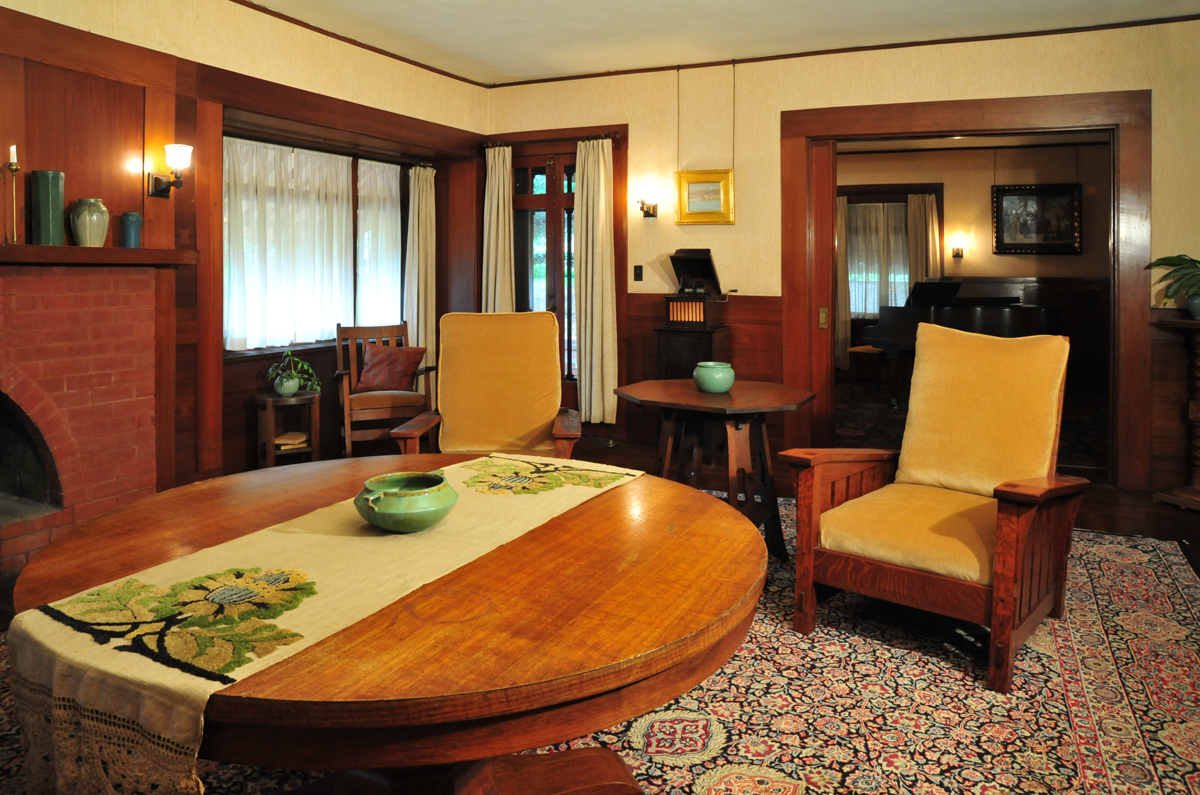
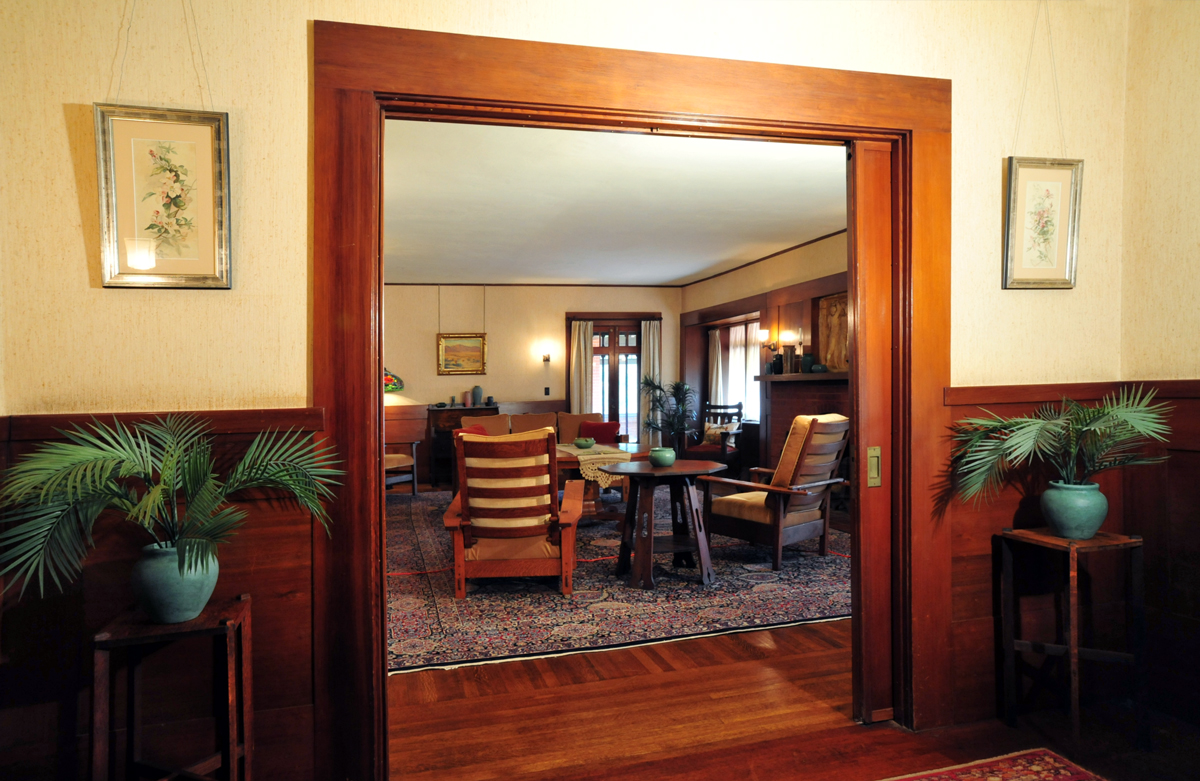
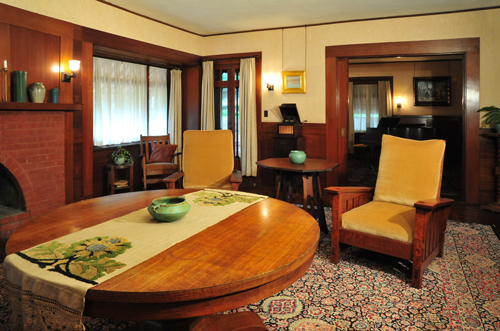 The velvet upholstered Craftsman furniture includes pieces by L. & J.G. Stickley and Lifetime Furniture. Replacing the original 1940s-era wallpaper chosen by Mary G. Marston, Harriet Marston Headley's daughter Margaret installed new, subtle grasscloth paper that extends into the adjacent music room. |
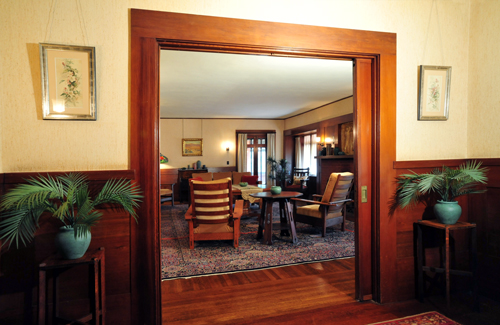 Two watercolors of California wildflowers by noted artist Albert R. Valentien, commissioned by La Jolla philanthropist Ellen B. Scripps, are displayed in the music room. From here, guests and family could view and mingle with the many musicians and friends who gathered in the living room to enjoy musical performances. All photos by Sandé Lollis |
Parlor: a derivative of the word parle (to speak), defining a room in a house designated for conversation and guests. A historic, elegant term which later earned a negative connotation due to the practice of hosting funerary wakes in these spaces. When commercial mortuaries replaced private home viewing, they received the sobriquet “funeral parlor.”
In the early 20th century, the Ladies Home Journal successfully campaigned to rename the chamber to entertain friends and family as the “living room,” encouraging the “rebrand” to make the space the "heart of the house" for daily activities like reading, conversation, and family relaxation.
The Marstons' new Seventh Avenue residence designed by Irving J. Gill in 1905 boasted a living room that would do just that, offering plenty of room to move around and socialize. Its clean, geometric lines, red-brick fireplace, and views to the vast lawn and trees provide a soothing connection to nature. The wide redwood board wainscot, partially attached with butterfly or bowtie keys, is both functional and decorative.
The fireplace, a slightly modified version of the firm of Hebbard & Gill’s usual style, anchors the room and frames a cast plaster reproduction by P.P. Caproni & Brother of Boston of an Italian Renaissance relief. The well-known Dancing Putti by Donatello may be an homage to the Marston’s children, who, it is said, inspired the purchase.
According to family oral history, the Marstons stored their former Ash Street home’s furnishings in their new attic and purchased a suite of Gustav Stickley’s quarter-sawn oak Craftsman furniture for their new library, living room, and dining room. In addition to cowhide- and sheepskin-covered chair seats, Stickley wisely offered velvet upholstery options along with silk and linen pillows that appealed to women, who wielded a fair amount of power in home decor choices. However, in 1909, George and Anna Lee replaced their Stickley furniture with more traditional pieces, including some family heirlooms.
The previous stewards of the Marston House Museum interpreted its interior as “Gamble House South,” a reference to a Greene & Greene masterpiece in Pasadena that is now a house museum. They furnished the Marston House with quality original Craftsman pieces upholstered in white linen. But this presentation reflected a later interpretive approach rather than the Marstons’ early years in the home. The removal and sale of those furnishings by the earlier stewards at auction in 2023 allowed SOHO to undertake a new interpretation of these rooms, one that more closely aligns with the family’s lifestyle during their first years of occupancy.
Craftsman furniture pieces donated to SOHO over the past several years have been rejuvenated and covered in a neutral, buff-colored velvet, reflecting Anna Lee Marston's known fondness for velvet. This presents a more accurate representation of how the Marston’s living room appeared soon after 1905. Along with embroidered textiles, a recent and generous donation of period pottery helps to accessorize the room.
One of the more “modern” furnishings the family retained was a Berkey & Gay dining room suite. The set’s original quarter-sawn oak pedestal table now serves as the living room’s center table, continuing a long tradition of centrally placed tables that anchored conversation areas in these rooms.
During its time in the dining room, this table hosted much of the brainstorming for the future Balboa Park, occasions energized with enthusiastic discussions on parks and city planning that would also shape at least one successful exposition. The Marstons’ lively dinner parties, attended by notable San Diegans, celebrities, and dignitaries such as Theodore Roosevelt, converged around this table as well.
Though the table was stored for many years and bears the wear of time, it remains one of the house’s most historically significant, surviving pieces of furniture and today it holds both practical and sentimental importance. Over time, the living room contained several tables and seating groupings that reflected the Marstons’ active social life. SOHO is studying these arrangements for further potential interpretation.
In the adjacent music room, the Marston’s Steinway baby grand piano—inherited by one of their grandchildren—held center stage for decades. The recent donation of a 1921 mahogany Kimball baby grand piano, stylistically similar to the second Steinway the Marstons owned, fills the small, intimate room. Flush with the wall behind it, a built-in sheet music cabinet completes the cohesive integration of private and social use in this space and the adjoining living room.
SOHO’s revitalization of these rooms allows guests to envision the Marstons and their company pulling up chairs around the hearth for an evening of conversation, laughter, music, and singing—perhaps much as their daughter Mary later described in her two-volume biography, George White Marston: A Family Chronicle. Imagine a congenial gathering on a chilly night, partly illuminated by embers glowing in the fireplace: George in his kilt and a well-practiced Scottish brogue, comedically impersonating the renowned Scottish vaudevillian Harry Lauder, with Anna Lee at the piano during those earliest years in the Marston House.
BACK to table of contents
Read the rest of the 2026 year-long series: Inside the Marston House.
|
2026
2025
2024
2023
2022
2021
2020
2019
2018
2017
2016
2015
|