|
Preservation is Housing Justice
Saving Buildings, Saving Communities
By Alana Coons
May/June 2026
If you watch enough crime dramas, you start to notice a pattern. The plot opens with an elderly tenant being forced out of her longtime apartment. Or a working family suddenly facing eviction because their building has been sold. Or a beloved neighborhood café or community center bulldozed for “luxury mixed-use.” By the final act, the culprit is often the same: a developer, smooth, well-financed, politically connected, and indifferent to who gets hurt along the way, but in real life, there’s no dramatic music, no detective to piece together what happened, no courtroom confession. Just a demolition permit, a fenced-off lot, and a notice to vacate.
 In real life, there’s no dramatic music, no detective to piece together what happened, no courtroom confession. Just a demolition permit, a fenced-off lot, and a notice to vacate. In real life, there’s no dramatic music, no detective to piece together what happened, no courtroom confession. Just a demolition permit, a fenced-off lot, and a notice to vacate.
When historic buildings, houses, and apartment buildings are demolished, we lose much more than brick and mortar. We lose decades of cultural heritage, architectural character, and, crucially for these times, we lose naturally occurring affordable housing (NOAH). These are the units that, by age and design, rent for far less than anything new construction can offer.
When NOAH disappears, so do the people who relied on it: seniors on fixed incomes, working families, artists, immigrants. They don’t magically “filter” into comparable housing. They scramble, double up, move farther out, leave their communities altogether, or end up in shelters or on the streets.
When a developer demolishes a historic or old building full of working-class tenants and replaces it with luxury units, they are not solving a housing shortage. They are converting it. They are taking homes that existed and making them homes that are out of reach.
For too long, the language around this issue has been sanitized. We talk about “unit replacement,” “redevelopment potential,” and “up-zoning.” But when people are forced out of their homes so higher-rent units can take their place, when a developer demolishes a block or an apartment building of affordable homes, it’s not called displacement. It’s called “redevelopment.” Each phrase is technically accurate and morally evasive in equal measure. Maybe it’s time we stopped using their language. The language is part and parcel of the con. We have built an entire vocabulary designed to launder what is, at its core, a transfer of wealth from the poorest residents to the wealthiest developers.
When affordable historic buildings are demolished despite feasible alternatives, that is a policy choice. When communities are hollowed out in the name of preservation and progress, as the City of San Diego's flawed project is called, someone benefits and someone pays. The market produces winners and casualties, but we rarely call the casualties by their right name. High-market units priced for elevated income brackets don't represent progress for those displaced; new luxury housing is a form of erasure.
Surely everyone has noticed how often developers rename new luxury complexes after the very places they destroyed, as if a name could substitute for lost homes, vanished communities, and obliterated histories. These projects serve a narrow audience of the affluent, while wiping away and destroying the city’s authentic character.
City officials and YIMBY advocates count new units, celebrate ribbon cuttings, and tout density targets. But where is the ledger for the people who were already there? Where is the accounting for rent-stabilized units lost, for retirees displaced from walkable neighborhoods, for cultural communities fractured house by house, block by block? These residents are treated as collateral damage in pursuit of production numbers, dire displacements no one tallies.
When misguided public policy, such as the Preservation and Progress program, fast-tracks demolition of older housing stock that has provided steady affordability for decades, it is not neutral policy; it’s a choice, a decree about who gets to stay and who is expected to move on. It is the opposite of democratic.
The question is not whether we want more housing. The question is, housing for whom? Housing justice shouldn’t be optional. If the answer consistently excludes the people already living in our neighborhoods, we are not solving a crisis; we are reshaping the city for a narrower, wealthier population.
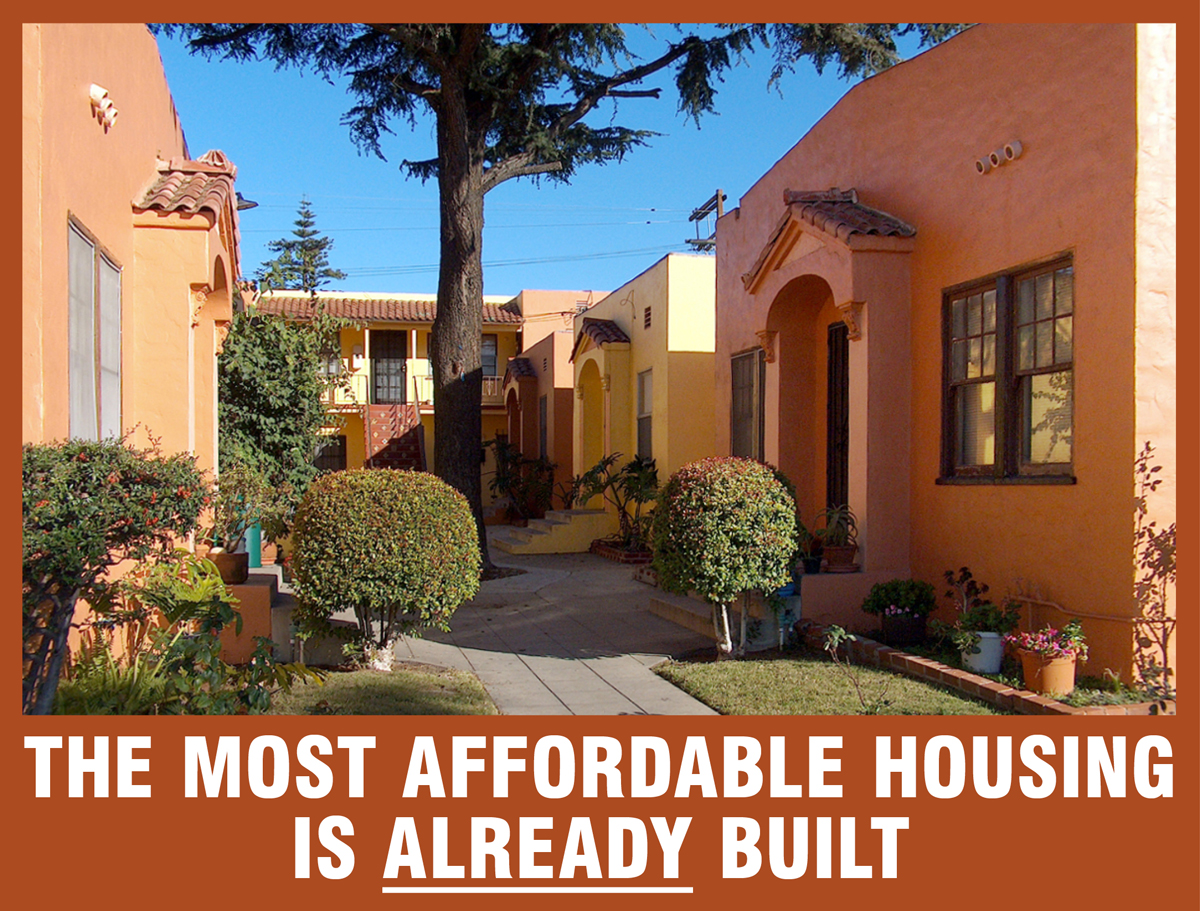
More than just a slogan, the greenest building is indeed the one already built. Likewise, the most affordable unit is most often the one already occupied. Demolishing a 1920s courtyard apartment community to replace it with “luxury studios starting at $2,800” doesn’t solve housing needs, it intensifies it.
When we defend historic districts and designated resources, we are protecting the lives and social and economic ecosystems embedded within them. We are defending community continuity.
Historic preservation is often caricatured as obstructionist, as if protecting older buildings somehow opposes new housing. But the truth is the opposite: Preserving existing, affordable housing stock is one of the most effective anti-displacement strategies available.
Not every developer is a villain. Some seek out and work with SOHO and the City's Historical Resources Board to incorporate historic buildings into new projects or pursue adaptive reuse. But the dominant development model relies on erasing existing communities to maximize land value, and it persists for one reason: profit.
Preservation is not anti-housing; it is anti-erasure. If we want a city that remains economically diverse, culturally rich, and genuinely inclusive, we must defend both the buildings and the people who make it so.
San Diego’s preservation efforts consistently prove that saving and repurposing historic buildings is a sound investment. Each preserved building tells the story of our city’s growth and transformation. Preservation fosters community development, a sense of place, and continuity—benefits that cannot be measured in units alone.
San Diego’s history is not a liability but an asset, attracting residents, visitors, and businesses alike. Developers who fail to appreciate history's role should not be the ones who dictate the city’s future. Adaptive reuse and preservation are not obstacles, they are opportunities for sustainable, inclusive growth. This and other major benefits of preservation are demonstrated in the new SOHO-commissioned study titled The Urban Vitality Blueprint: A Data-Driven Analysis of Equity, Affordability, and Vitality in San Diego’s Historic Districts (PlaceEconomics, February 2026).
We should insist on accountability during this current building boom: every unit lost, every displaced family, every disrupted neighborhood must be counted. Developers should have to demonstrate, not merely assert that their projects leave communities better off.
Every time someone says “redevelopment,” ask: redeveloped for whom? Every time someone says “new housing supply,” ask: at what price, and at whose cost? Every time a planning approval ticks by in the local paper in three paragraphs, ask why the people who lost their homes aren’t in the story.
If we want a city that remains vibrant, diverse, and resilient, we must take these lessons seriously. Preservation is not a luxury, it is housing justice, cultural continuity, and a strategy for equitable growth. Unlike television dramas, real-life displacement doesn’t wrap up neatly in an hour, it’s time we start telling that story plainly, loudly, and without apology.
BACK to table of contents
|
2026
2025
2024
2023
2022
2021
2020
2019
2018
2017
2016
2015
|