|
San Diego’s 45-Year Review: Why Historic Surveys Matter
May/June 2026
Many SOHO members follow historic designation cases closely, but fewer people see what actually happens inside City Hall when an owner applies for a development permit for a building that may be historic.
San Diego's 45-year review is the process city staff uses to determine whether a property might qualify as a historic resource before a permit moves forward.
Today, the City of San Diego is considering changes to its historic designation process that would significantly endanger the preservation of individual properties and historic districts. Among these changes, which are part of the Planning Department’s Preservation and Progress program, is a proposed move away from the 45-year review process.
SOHO maintains this potential “update” would present significant risks. Eliminating the 45-year review before completing a comprehensive citywide survey would expose countless historic structures to irreversible loss.
While thousands of permits may trigger the 45-year review each year, only a small percentage advance to formal historical studies or to the Historical Resources Board, as the entire city contains only 1% or less historic resources.
Here's what happens during the review: When a building that is 45 years old or older enters the City of San Diego’s permit process, it automatically activates the 45-year review, a preliminary screening of a potential historic resource before construction proceeds. Many people only learn of these candidates for landmarking post-screening, when a proposed project involving such a structure reaches the Historical Resources Board (HRB). But most of the evaluation actually happens much earlier—quietly and quickly—within the City’s Development Services Department and Heritage Preservation staff.
When an owner, architect, or contractor submits a permit application for work on a property, City staff first review the application for completeness. Under the San Diego Municipal Code, any permit involving a structure that is 45 years old or older requires a Potential Historical Resource Review, known colloquially as the 45-year review. Applicants must typically provide photographs of the structure, project drawings and a site plan, and building record information drawn from county or assessor files.
Using these materials and other available building records, staff evaluate the structure for potential historic significance. If it does not appear to meet the criteria for historical significance, the permit moves forward through the normal building review process. However, if Heritage Preservation staff thinks that the property may be historically significant, they conduct a deeper evaluation that may include historic context research, architectural analysis, and an integrity assessment, comparing the property to the HRB designation criteria, and the applicant may be required to prepare a Historical Resources Research Report—a detailed study prepared on standardized City forms, usually by a qualified historian or architectural historian.
If that report concludes the property may meet the city’s designation criteria, the site generally is referred to the HRB. It holds a public hearing and determines and votes on whether the property should be formally designated as a historic resource. If the board designates the property, future construction work and restoration or rehabilitation must comply with the City’s historic preservation regulations and the U. S. Secretary of the Interior’s Standards; if the HRB does not deem it historic, the permit application continues through the standard building process.
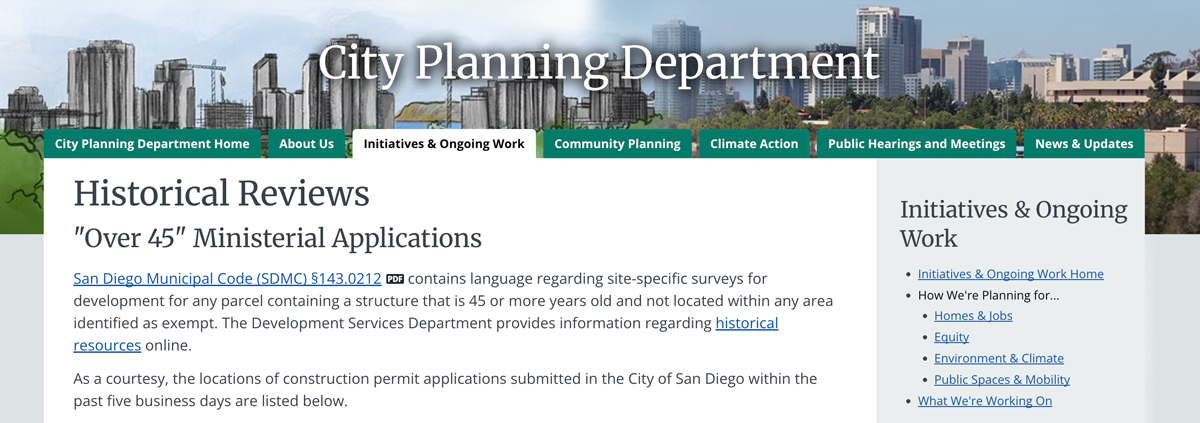
The mechanics of these review procedures have changed over time. In 2019, the City altered a decade-old notification system that had been developed through a public process. Previously, the City distributed a regular email that listed properties undergoing 45-year review, including addresses, planning areas, photographs, and a public comment deadline. That system allowed preservation groups and community members to quickly understand what buildings were under review and to respond if necessary.
The revised system replaced those notifications with a continuously updated list posted on the City’s website, showing permit applications for properties over 45 years old but without the same level of detail. The change also cut the public comment window in half—from ten business days to five—and removed photographs and planning-area information, requiring anyone interested in monitoring potential historic resources to conduct their own research before commenting.
SOHO formally objected to the change at the time and, along with other stakeholders, met with City staff. The only adjustment the City made afterward was to add posting dates to the listings. The underlying challenges remain.
Even so, the preservation community continues to monitor these cases closely. Bruce Coons, SOHO’s executive director, for example, reviews every 45-year review listing that the City posts, weighing which properties may warrant further examination and conveying his concerns to City staff when necessary.
In many neighborhoods, community preservationists also monitor the posted listings for their planning areas and flag buildings that may have historic significance. In other words, although the City attempted to reduce or limit the visibility of this early review stage, the public still finds ways to stay vigilant and engaged in the process. As activists like to say: We persist.
SOHO and the Neighborhood Historic Preservation Coalition recently provided the City with a simple, clear solution: Rather than eliminating the 45-year review, whether as proposed or currently under discussion, the City should complete a comprehensive citywide historic resources survey and promptly process the resulting recommendations for both district and individual designations. This proactive approach would ultimately eliminate the need for the 45-year review by identifying historic resources in advance, thereby providing certainty for the City, residents, preservationists, and developers alike. It would also significantly reduce workloads for everyone involved in the current review process. Any new data and recommendations that emerge later could be digitally entered into the public records.
Until comprehensive surveys are completed, however, the 45-year review remains a necessary safeguard and cannot and should not be eliminated.
The City could move forward by simply addressing the backlog of historic district designations currently sitting in the queue. To tackle this critical delay, the City could streamline internal review processes and establish clear timelines and accountability measures for advancing district nominations. San Diego has not approved a local historic district since 2017, despite more than a dozen districts currently awaiting action, many of which have broad community support and meet established eligibility criteria.
This situation creates serious CEQA (California Environmental Quality Act) vulnerabilities for the City and its citizens’ quality of life and cultural heritage, because without adequate environmental review, unprotected historic districts are at increased risk of piecemeal demolition and incompatible development. It also undermines the City’s planning consistency, particularly in areas identified in community plans and historic surveys as having valuable historic fabric.
A practical solution already exists and preservationists have presented it, complete with proposed language, to the HRB: The City could streamline the local designation of districts that are already listed on the California or National Registers of Historic Places by amending its guidelines to create a clear, expedited process for local designation. Because these districts have already undergone rigorous research and evaluation, a streamlined procedure would avoid unnecessary duplication and expense, reduce delays, and ensure timely protection.
Doing so would also reinforce community planning goals, expand access to preservation incentives, and ensure meaningful protections are in place to safeguard neighborhood character and cultural heritage. It would be a win for the City, the public, the development industry, and the historic resources the City has a responsibility to protect.
City leaders should be asking staff why this simple, straightforward, and responsible approach has not been pursued. Instead, the current Preservation and Progress proposal introduces a far more convoluted, complex, and cost-prohibitive framework. The public—and the City Council—should be asking why.
BACK to table of contents
|
2026
2025
2024
2023
2022
2021
2020
2019
2018
2017
2016
2015
|