|
Deo Gratias (Thanks be to God): San Diego County’s Religious-Themed State Historic Landmarks
Hiding in Plain Sight, Part 4
By Alexander D. Bevil, California State Parks Historian II (Retired)
May/June 2026
Religious in nature, the following state landmarks date back to San Diego's Mission and Pueblo eras. The Mission era sites are associated with Spain's attempts to convert and assimilate local indigenous peoples into its colonial empire. One asistencia, or sub-mission, continues to serve its original Mission Indian Tribe, the Pala Band. The last two landmarks listed are in Old Town San Diego and represent the first pioneer-founded, non-mission church and cemetery created by San Diego's local Roman Catholic community.
California Historic Landmark (CHL) No. 67: Serra Palm Site
On July 1, 1769, Father (now Saint) Junípero Serra said Mass and prayers near the foot of Presidio Hill in San Diego over the graves of the members of Spain’s “Sacred Expedition” who died while founding a fort and mission at San Diego Harbor.
CHL No. 59: San Diego Presidio Site
On the hillside just above the graves, on July 16, 1769, Father Serra founded Mission San Diego de Alcalá, intending to convert (some say coerce) the local Kumeyaay into the mission system. A wooden palisade surrounding the mission and fort’s crude structures indicated that the locals were far from acquiescent. Indeed, by 1774 the presidial soldiers’ rapacious treatment of the neophytes forced the padres to relocate the mission six miles inland near the Kumeyaay village of Nipaguay. A priest would return to the coast to perform religious ceremonies or services in a new adobe block chapel, erected on the former mission’s site, from 1804 until the fort’s eventual abandonment in 1837.
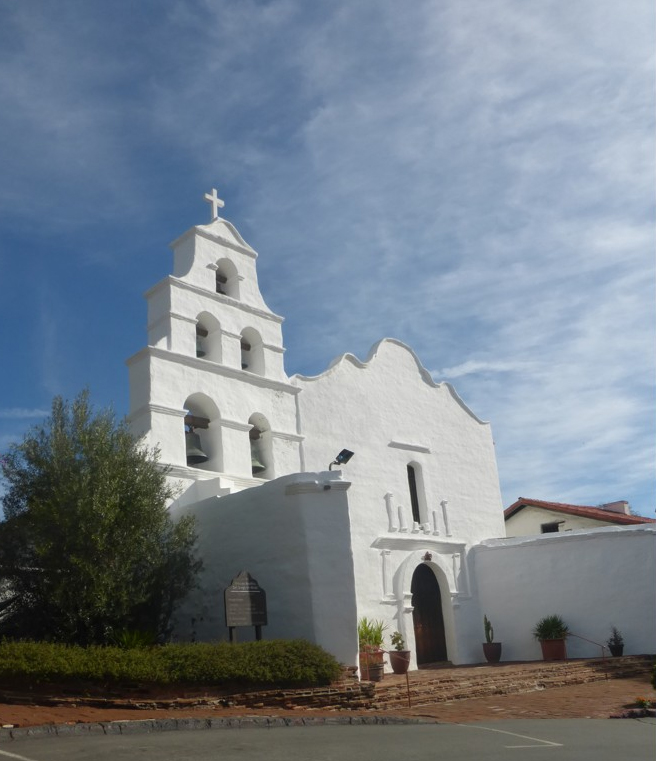
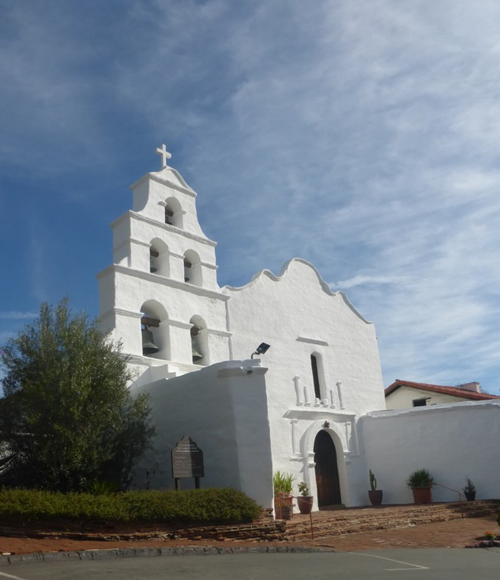 CHL No. 242: Mission San Diego de Alcalá. The current church is a 1931 reconstruction of how it looked in 1813. It has been in use as a local parish church since February 1941. Originally designated on June 10, 1936, a new bronze plaque was installed on July 16, 1989; however, it was stolen from the site on April 4, 2023. Location: 10818 San Diego Mission Road, San Diego. Photo by Alex D. Bevil |
CHL No. 242: Mission San Diego De Alcalá
On November 4, 1775, a large-scale Indigenous revolt destroyed the newly relocated, crude wood and tule buildings. Among those killed was Padre Luis Jayme, California’s first Roman Catholic martyr. Despite the attack, the padres—along with several master Spanish and apprentice neophyte craftsmen, artisans, and laborers—rebuilt and expanded the “Mother Mission.” Secularized in 1834, the structure slowly deteriorated. Designated by the state on June 10, 1936, the mostly reconstructed church building has been in use by the local Catholic parish since February 1941.
CHL No. 562: La Christianita
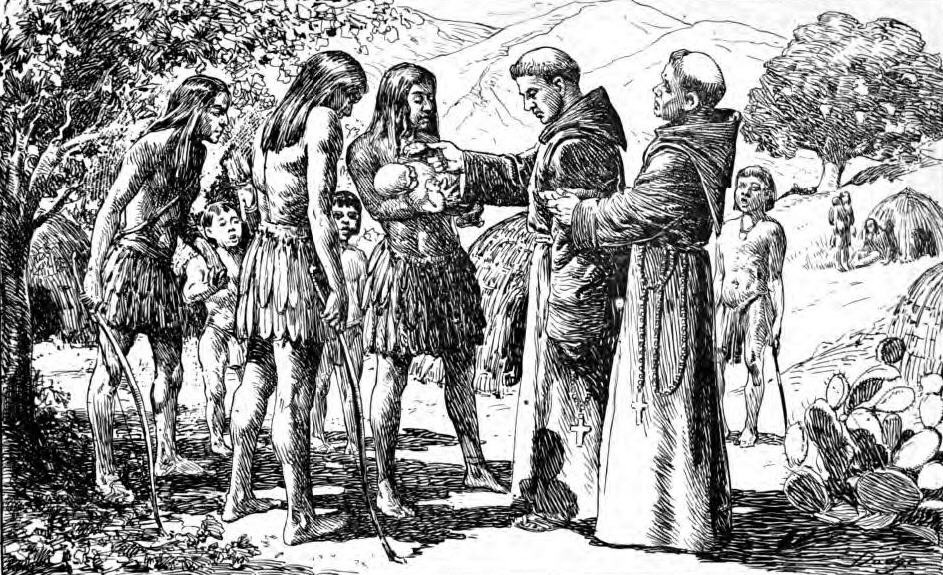
In the northwestern section of Camp Pendleton, on July 22, 1769, Padres Francisco Gómez and Juan Crespí of the Portolá Expedition baptized two ill Acjachemen children with their Indigenous parents’ cautious consent. Designated on December 31, 1956, as the site of the first recorded Christian baptism in California, the marker commemorates a foundational moment in California’s colonial-era religious and Spanish exploratory narrative.
CHL No. 239: Mission San Luis Rey De Francia
Father Fermín Lasuén, the second president of the California missions, founded this mission on June 12, 1798. Father Antonio Peyrí and master carpenter José Antonio Ramírez completed it in 1821. Reportedly the largest adobe building in California, the “King of the Missions” (in Oceanside) reflected a combination of Spanish, Mexican, Moorish, and Italian architectural influences. The writings of Father Pablo Tac, a Luiseño protégé of Fr. Peyrí, provide valuable insight into mission life from a Native perspective and form the first grammatical guide written by an Indigenous person. An active religious center, it received landmark status on June 10, 1936.
CHL No. 52: Mission Dam and Flume
In 1797, presidial journeyman stonecutter and mason Toribio Ruiz of Jalisco, assisted by Mission Indian laborers, initiated the dam’s construction approximately six miles northeast of Mission San Diego. By 1816, Baja California native master mason Miguel Blanco had completed the project, which included a V-shaped, cement-mortared tile and fieldstone flume. Without California’s first recorded engineering project, the mission might not have had a reliable supply of San Diego River water for crops and livestock. While seasonal floods washed away all but 500 feet of the flume, the majority of the dam’s masonry walls are intact.
CHL No. 243: Asistencia San Antonio de Pala
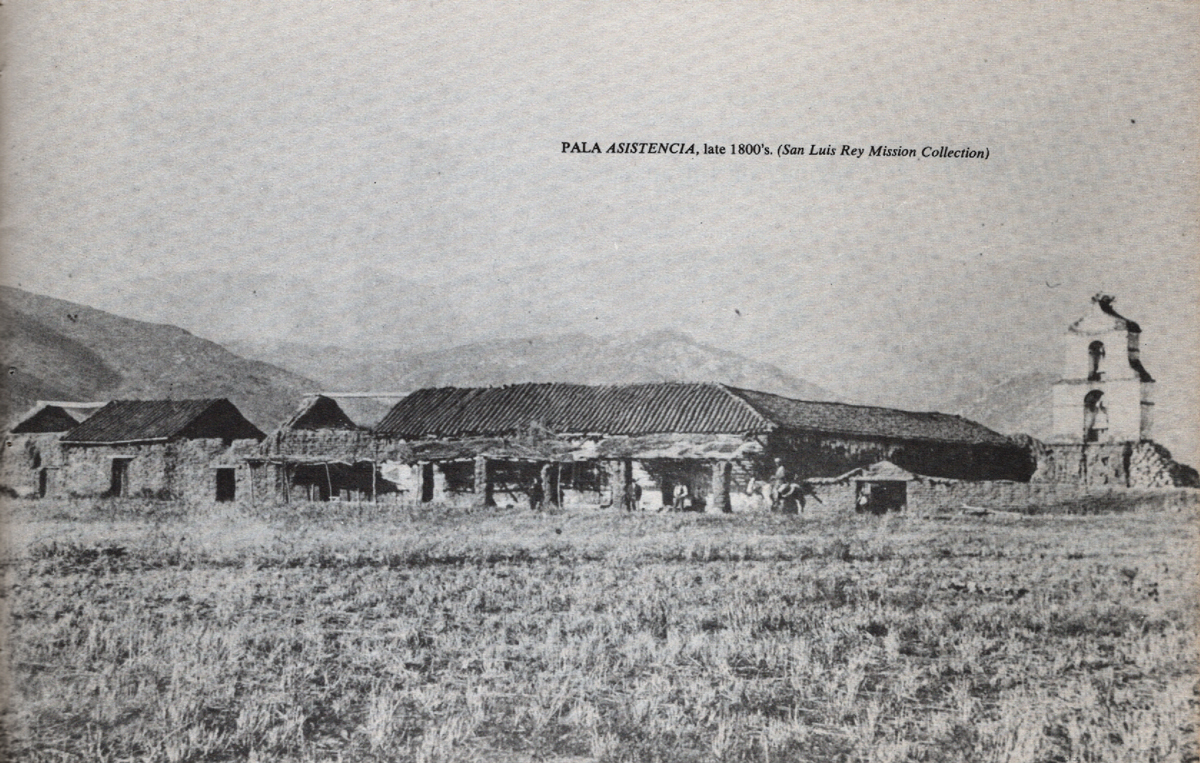
Father Peyrí located this sub-mission or asistencia of Mission San Luis Rey near a traditional Native gathering place. Its freestanding, pierced wall campanile is a landmark in Pala. Designated on June 10, 1936, and restored in 1948, it is the only surviving Mission-era chapel to continue serving the Indigenous tribal community for which it was intended.
CHL No. 369: Santa Ysabel Asistencia Site
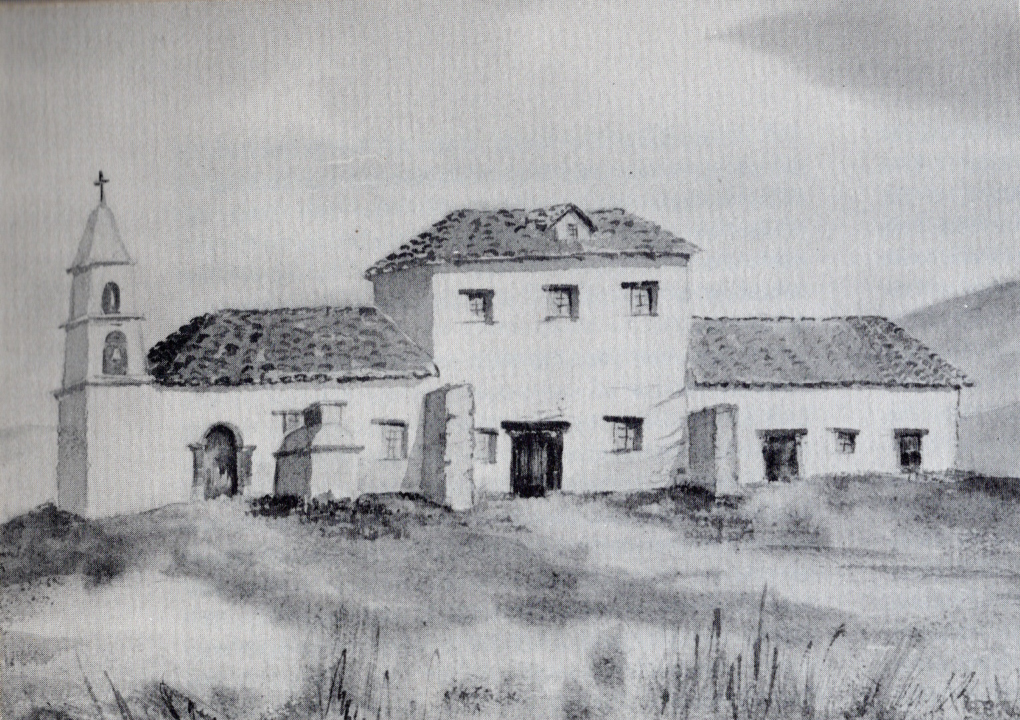
Father Fernando Martín celebrated Mass and baptized approximately 500 local Indigenous people near this site on September 20, 1818. By 1822, he had erected a small adobe-and-tile chapel with outbuildings and a cemetery. An asistencia of Mission San Diego, it was to serve as the “mother” of a chain of inland missions. After passage of the 1833 Decree for the Secularization of the California Missions, that plan, along with this chapel, was abandoned. The adobe melted to ruins by 1850. Religious services returned in 1924 with the erection of a nearby chapel.
CHL No. 616: Las Flores Asistencia
Prior to 1823, Fr. Peyrí relocated several families of Mission Indians to a new village site of Las Flores, where they were directed to build a small tile-roofed adobe chapel and hostel for clergy and others traveling between Missions San Luis Rey and San Juan Capistrano along El Camino Real. Located midway between the two missions, it was actually an estancia, a farming and livestock ranching “station” associated with the surrounding San Pedro Rancho. Abandoned after the secularization decree, its ruins are 1,000 feet west of the restored 1867-68 Las Flores Adobe at Camp Pendleton.
CHL No. 68: El Campo Santo
Established in 1849, “The Holy Field” in Old Town San Diego once contained the remains of some 477 Catholic San Diegan pioneers. However, after 1874, several notable burials were relocated to the new Calvary Cemetery in Mission Hills. Perhaps the most notable remaining burial is that of Antonio Garra. A Cupeño tribal leader, his gravesite marks the site of his 1852 execution by firing squad for organizing an Indigenous rebellion against unfair taxation and the loss of ancestral lands to squatters. Ten years after an 1887 street railway project bisected the cemetery, burials ceased altogether. Five years after its December 6, 1932 landmark designation, a street widening project removed all evidence of the burials southwest of San Diego Avenue.
CHL No. 49: Adobe Chapel of the Immaculate Conception
The same 1937 street widening that desecrated El Campo Santo also necessitated the relocation of Old Town San Diego’s first Catholic church, which had been designated as a state landmark five years earlier. WPA workers respectfully exhumed the remains of Don José Aguirre, who had purchased and donated the former John Brown adobe home to the church in 1858, and reburied them beneath a marble slab in a side chapel.
BACK to table of contents
Read the rest of the ongoing Hiding in Plain Sight Series.
|
2026
2025
2024
2023
2022
2021
2020
2019
2018
2017
2016
2015
|