|
San Diego Historical Resources: Designations and Board Reports
By Ann Jarmusch
March/April 2026
At its January 2026 meeting, the City of San Diego Historical Resources Board designated three homes, including a 1928 Colonial Revival cottage that HRB staff did not recommend for designation. The board voted to designate this house after several extensive presentations in support of its architecture and place in the historic national Better Homes Movement that championed smaller homes. These presentations featured analysis and history and were contributed by the home’s owner of 36 years and, separately, by Bruce Coons, SOHO executive director; and by SOHO president David Goldberg, speaking for himself, among others.
Members also approved historical conservation elements to comply with a Special Use Permit for a La Jolla Heritage Structure at 484 Prospect Street. Without impacting the exterior, the 16,683-square-foot single-family home is to be converted into a commercial, 19-room hotel. The board approved the property’s Heritage Structure designation on September 25, 2025.
Board member Michael Provence noted that he sent a letter to fellow HRB members and staff (you can read it online) to clarify and memorialize why he voted against Package A of the City's Preservation and Progress program. Provence emphasized that the HRB voted it down twice and did not advance it, as expected, through the City's committees leading up to the City Council's vote. Board member Anna Farley also said she strongly opposed Package A. These board statements follow HRB Chair Kristi Byers's generally supportive comments on Package A at meetings of the Planning Commission and the City Council's Land Use and Housing Committee.
Later in the meeting, Planning Department Deputy Director Kelley Stanco reported that, like the Planning Commission before it, the Land Use and Housing Committee recommended approval of Package A with a recommendation to monitor for a year a controversial new procedure that increases the City Council's power to overturn HRB designations. Provence, Farley, and other preservationists, including SOHO, Mission Hills Heritage, the Neighborhood Historic Preservation Coalition, and the Community Planners Committee, vigorously oppose this change because it would allow the Council, a politicized body of laymen, to overturn historic designations made by professional historians, architects, an archaeologist, and others selected for their expertise to serve on the Historical Resources Board.
At the suggestion of board member David McCullough, the board explored proactively nominating as masters living architects, designers, builders, and landscape architects who have significantly shaped San Diego. Presently, the only designated living master is architect Jonathan Segal. Member Rammy Cortez said that Segal nominated himself, probably at considerable expense, in a move to help protect his architecture from unwanted alterations. The board may form a subcommittee for this nominating and/or work new procedures into Preservation and Progress's Package B in coming months.
During public comment, architect Jennifer Ayala announced the recent death of San Diego attorney Marie Burke Lia, and paid tribute to her 37-year career focused on historic properties.
Here are descriptions of the three homes the board designated as historic:
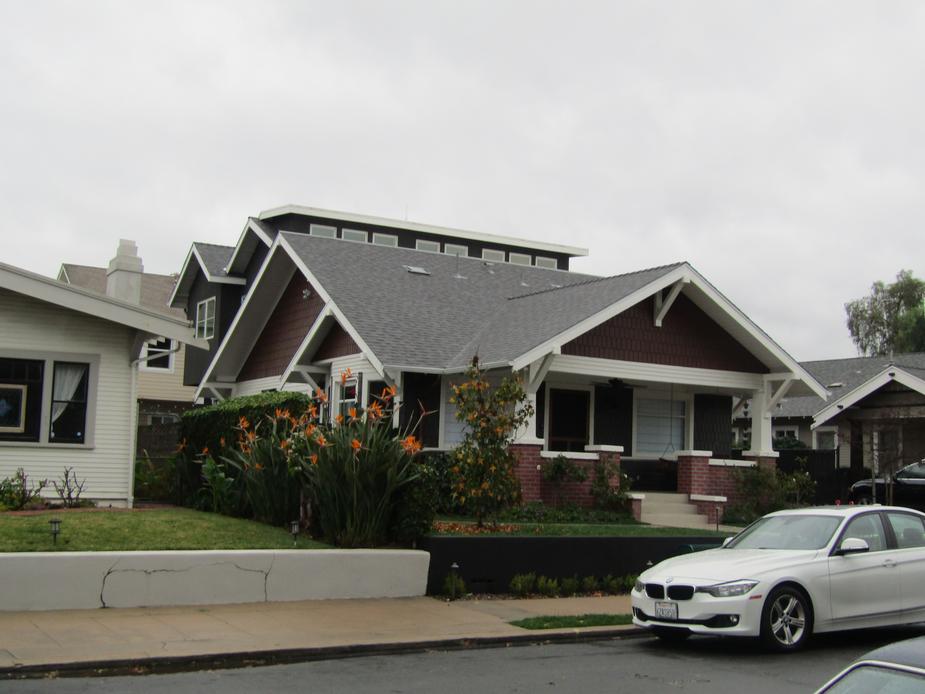 3783 Pioneer Place in Uptown is the Alwyn and Emily Patterson House, built in 1915 in the Craftsman style. It merits designation under HRB Criterion C, for architecture, because it retains architectural integrity and many Craftsman design hallmarks. Among these are a partial-width front porch supported by battered posts and brick piers, the original wooden, glazed front door; a cross-gabled roof; overhanging eaves with exposed rafters; triangular knee brackets; wood shingle siding above the wood band at the sill line and varied reveal, horizontal wood siding below; wood frame and sash double-hung and fixed windows; and decorative attic vents. The designation excludes the detached two-story 1928 apartment building, the detached 2021 garage, and the 2021 two-story addition. |
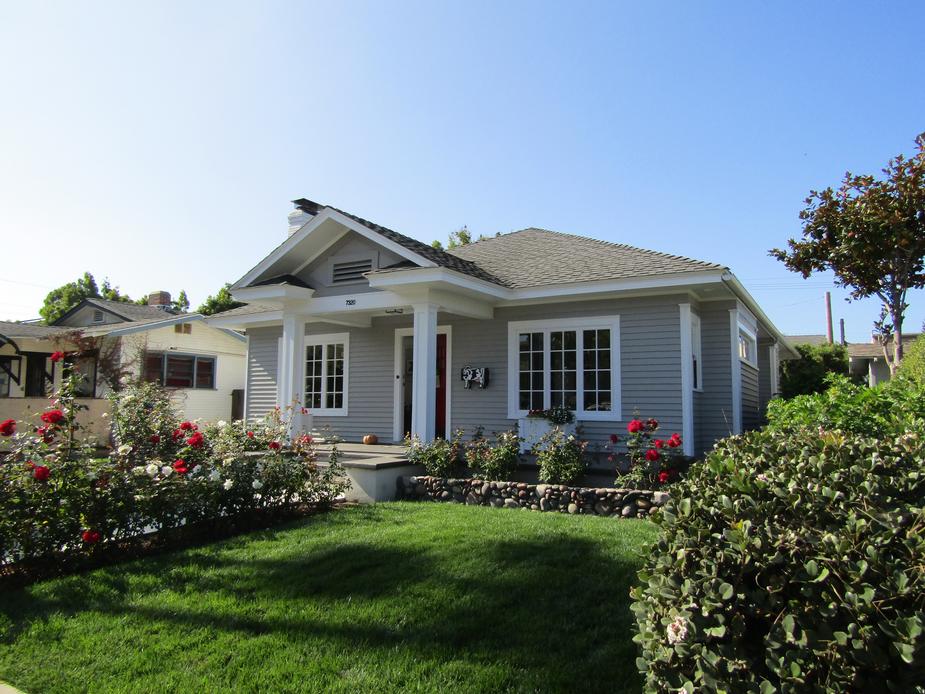 7318-7320 Fay Avenue in La Jolla was praised by supporters as a rare example of a disappearing resource: a modest, middle-class home built in 1928 that retains its original features and integrity in what is now an affluent neighborhood. Named the Judson and Mary Ferguson House, the one-story Colonial Revival cottage is designated under HRB Criterion C for embodying elements of the style. These character-defining hallmarks include a moderate-hipped roof, double-hung windows with multiple panes, a portico with pediments, a symmetrical facade, wood clapboard siding, and an enlarged chimney. The designation excludes the rear building. |
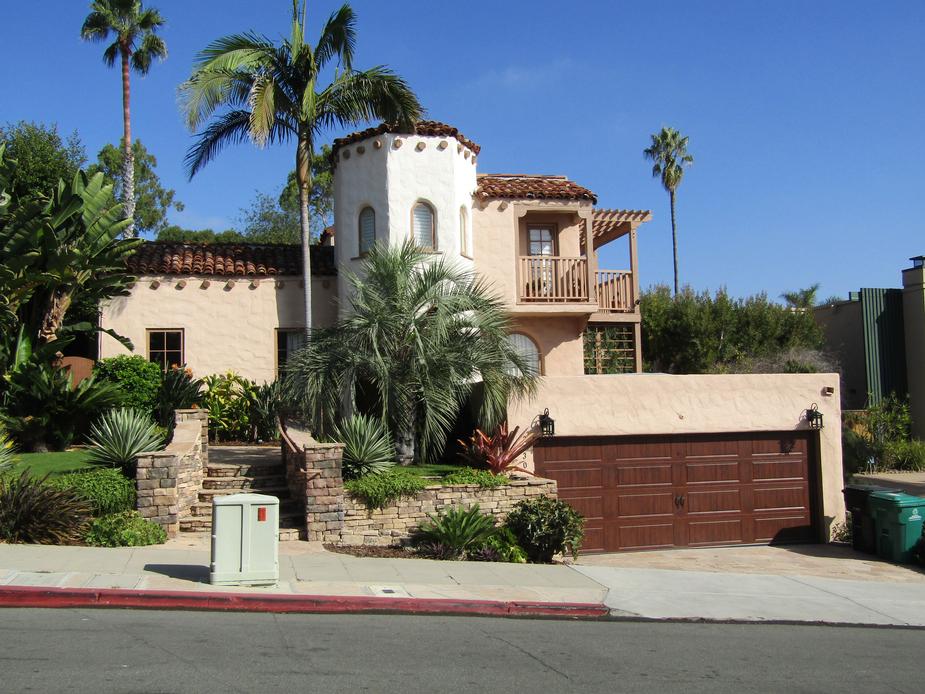 2930 McCall Street in Point Loma is the Manuel and Bertha Cabral House, a 1928 Spanish Colonial Revival residence. It retains the style’s distinctive architectural elements, materials, and integrity, so the board designated it under HRB Criterion C. Specifically, the resource features asymmetrical massing, an arched front door, a decorative novelty stucco exterior, varied roof forms, a tile roof with little eave overhang and vigas, a second-story full-width balcony, a central tower, stucco chimney, and wood-framed fenestration consisting of casement and double-hung windows. |
City of Coronado Designations
The Historic Resource Commission designated one house on November 5, 2025:
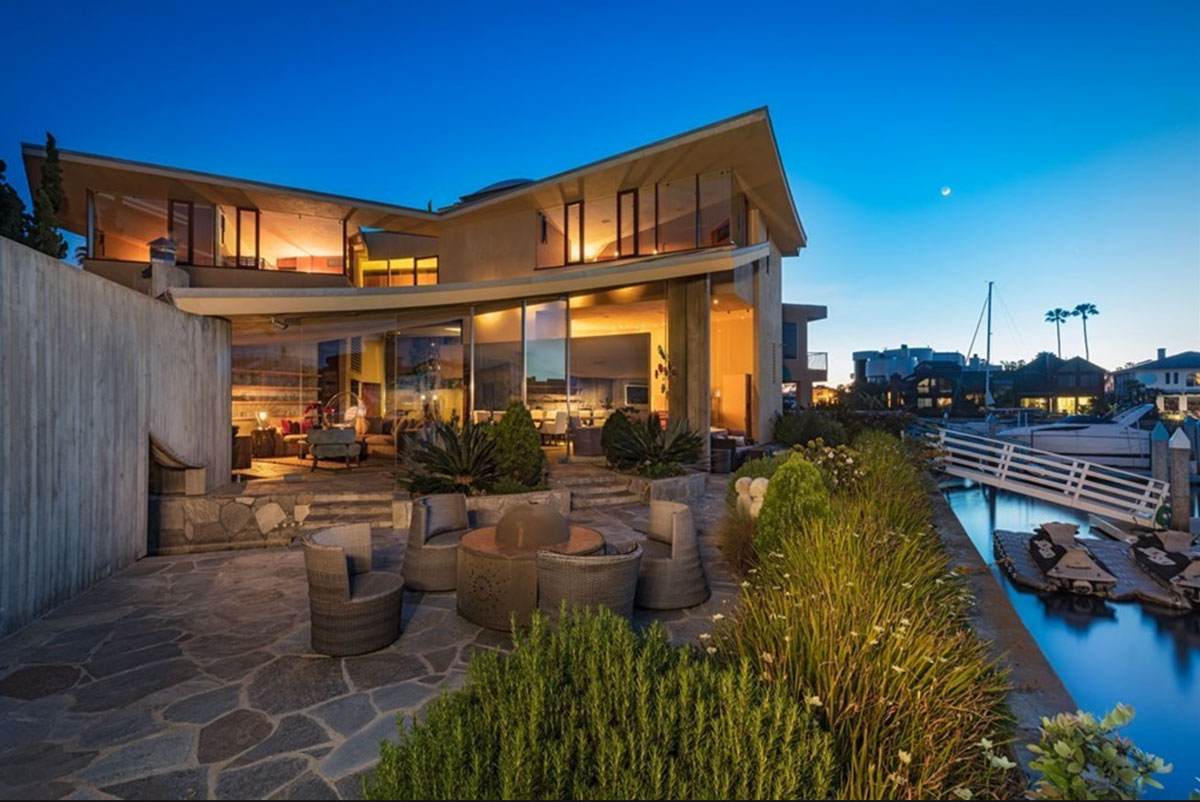
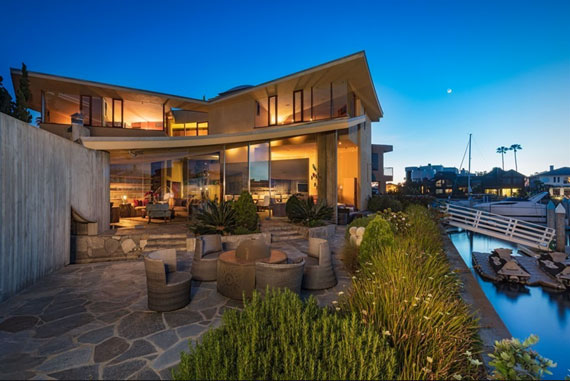 15 Green Turtle Road is the only known work of Mid-Century Modern master architect John Lautner in Coronado and San Diego. He designed the single-family home and attached garage on San Diego Bay in the Organic Geometric style. Built in 1992, the design takes advantage of its bayfront setting in Coronado Cays and is meant to blur the lines between the architecture and its surroundings, a key concept of the style. Character-defining features include asymmetrical facades; an unusual roofline that uses natural shapes; sharp angular massing; the integration of technology and organic materials, including wood and stone; and exterior walls made of fluid concrete planes and large glass panels to manipulate vistas and create a strong relationship between the architecture and its natural surroundings. It retains enough original characteristics to be considered a true and rare representative of the Organic Geometric style in Coronado. It meets HRC Criterion C, for its architecture, and Criterion D, as the notable work of architect Lautner, a renowned and influential innovator well known for such dramatic and iconic Los Angeles homes as the Elrod House, the Chemosphere, and Silvertop. Their transparency and futuristic qualities set on seemingly precarious perches in the sky led to fame for Lautner via stunning magazine spreads and unforgettable movie locations. No two Lautner designs are alike, and this residence is the prolific architect’s last documented design and integrates many of the techniques he developed over time. Courtesy Redfin |
At its February meeting, the HRB designated one home and recommended to the Planning Commission its approval of the historical resources section of a site development permit for a designated North Park building. They also created an ad hoc subcommittee to discuss the Historical Resources Board Designation Criteria and ratified board member appointments to it and to the established Policy, Design Assistance, and Archeological and Tribal Cultural Resources subcommittees.
Here are descriptions of the two historic properties the board addressed:
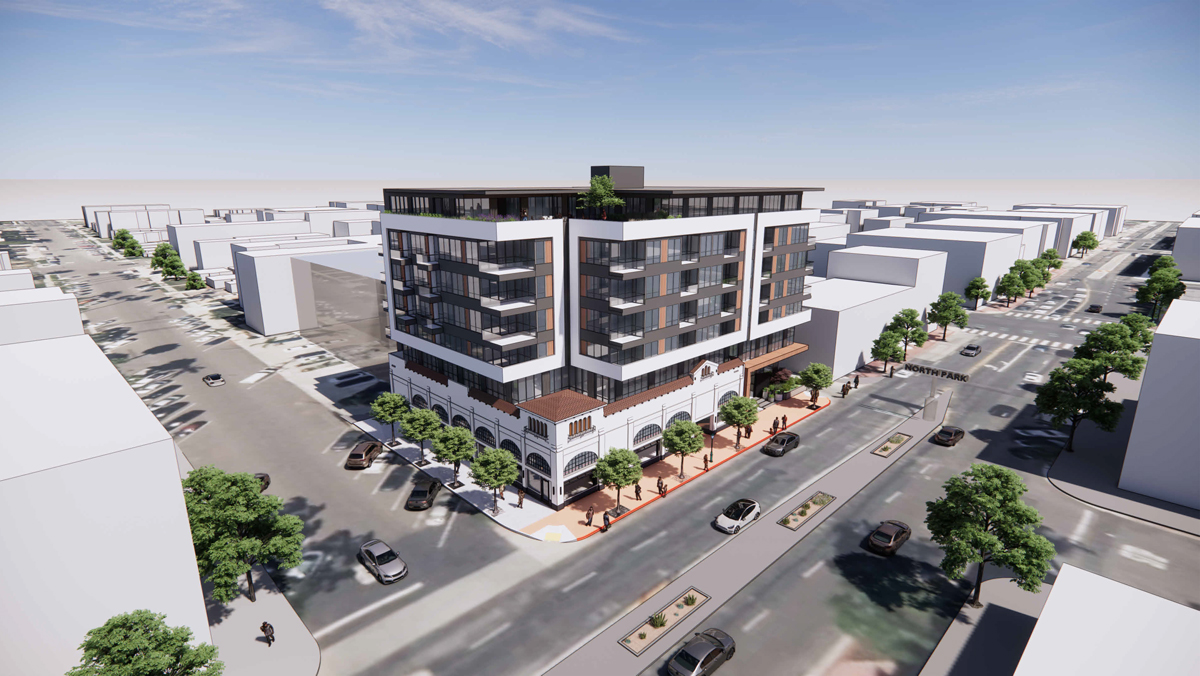
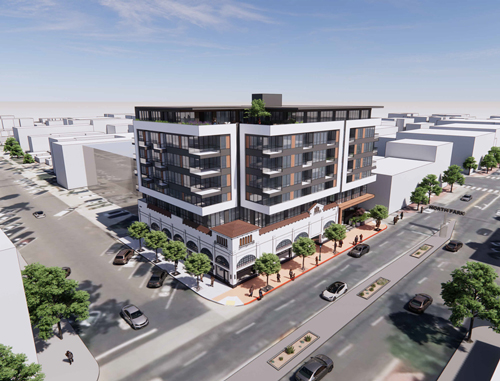 2906-2920 University Avenue Site Development Permit in North Park for a two-story Spanish Colonial Revival commercial structure, known as the Edward and Emma Newman Building (HRB #1482, period of significance 1929-1932). The new construction—a seven-story mixed-use multi-family residential development with 92 units and ground level commercial space—would retain and rehabilitate the Newman Building's west and south facades, and demolish the rest and the adjacent non-historic building. Courtesy Purpose Real Estate, Inc. |
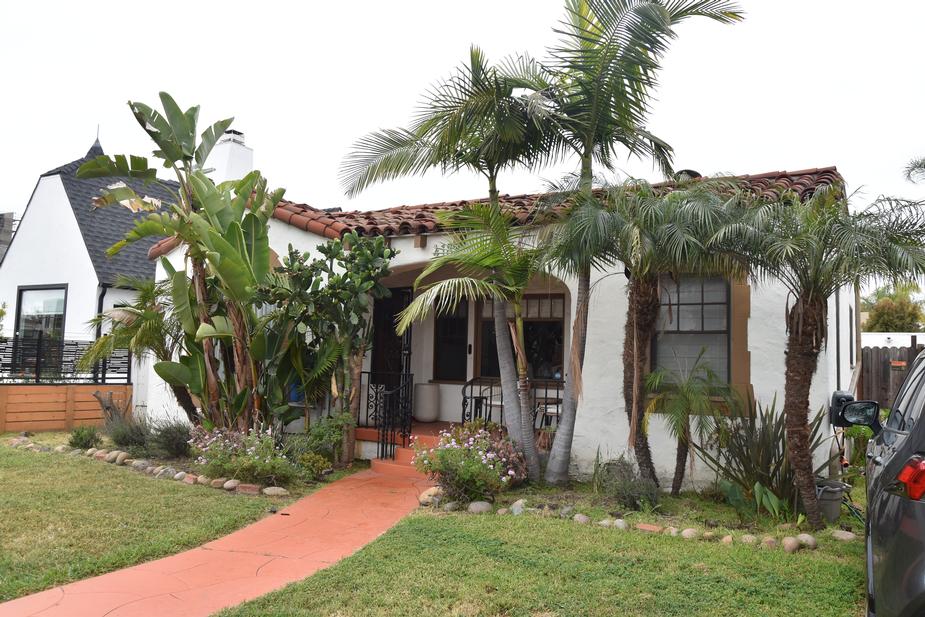 4182 Utah Street in North Park is the Ronald and Pearl Brock Spec House #1, is designated historic under HRB Criterion C (architecture): It embodies the Spanish Colonial Revival style and retains integrity from its construction in 1931. Among the home's distinctive characteristics of the style are a recessed front entry porch with an arched opening, a large arched picture window with decorative quoining, a low-pitched cross-gable and flat parapet roof with mission barrel tile, minimal eave overhang, decorative rafter tails, medium sand stucco cladding, clay attic vents, wood-framed multi-light and single-light double-hung and fixed windows, and a stucco chimney. The designation excludes the rear detached garage. |
All photos are from the California Historical Resources Inventory Database (CHRID), except where noted otherwise. The above designations were reviewed and approved by the City of San Diego Historical Resources Board (HRB), the County of San Diego Historic Site Board (HSB), or the Coronado Historic Resources Commission.
BACK to table of contents
|
2026
2025
2024
2023
2022
2021
2020
2019
2018
2017
2016
2015
|